GEO & AI Search
Week 4: Off-Site Authority Building - Citation Signals
Quick Answer
Week 4 builds the off-site authority signals that complete your GEO foundation. Days 22-23 optimize directory listings and business profiles. Days 24-25 secure strategic third-party mentions. Days 26-27 align social profiles for entity consistency. Day 28 validates your off-site presence. This matters because 85% of AI brand mentions come from third-party sources-what others say about you determines whether AI platforms cite you.
Your website is ready. Your content is structured. But AI platforms don't just look at your site-they look at what the rest of the internet says about you.
Here's the uncomfortable truth: AI platforms are more likely to cite third-party mentions of your brand than your own website. When someone asks ChatGPT for "the best CRM for small business," the response pulls from reviews, directories, comparison articles, and industry lists-not from your homepage. If you're not present in those places, you're invisible.
Week 4 builds the off-site authority signals that complete your citation foundation. By Day 28, you'll have directory listings optimized, third-party mentions secured, and social profiles aligned-the external validation AI platforms need to recommend you.
85%
of AI brand mentions from third-party sources
Only 13.2% of AI citations trace back to brands' own domains. External validation dominates.
Source: AirOps →6.5x
more likely to be cited from third-party sources
In brand discovery queries, external sources dramatically outperform first-party content.
Source: AirOps →90%
of third-party mentions from listicles and comparisons
List-style content and comparison articles drive the vast majority of AI citations.
Source: AirOps →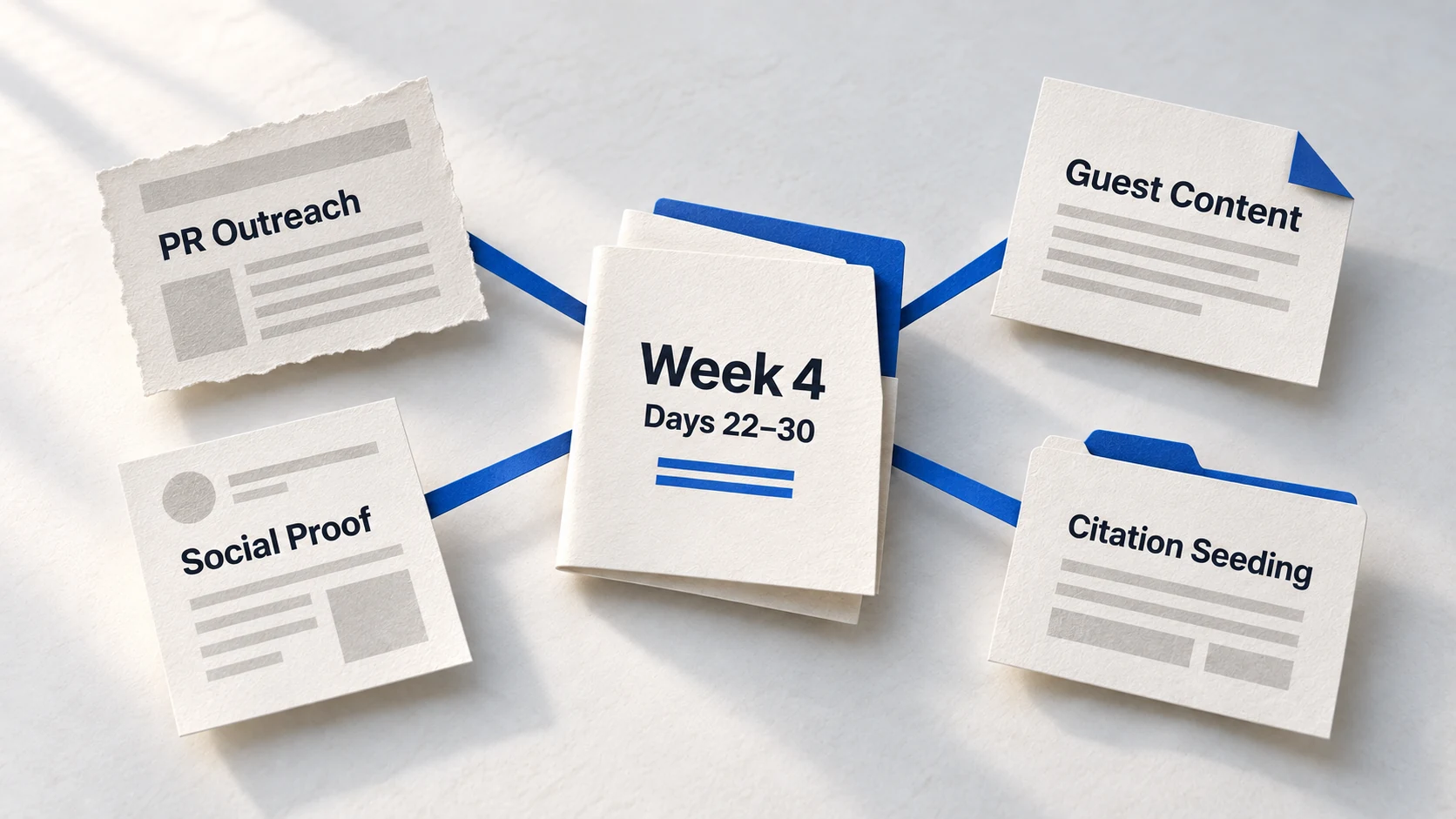
Why Off-Site Authority Matters More Than Ever
Traditional SEO taught us to focus on our own website: optimize content, build backlinks, improve technical signals. But AI platforms have flipped the script. They're not just crawling your site-they're reading what everyone else says about you and using that consensus to determine whether you're citation-worthy.
Definition
Off-Site Authority
The sum of external signals that establish your brand as a recognized entity worth citing. This includes directory listings, third-party mentions, reviews, social profiles, and any content about you that exists outside your own website. AI platforms use off-site authority to verify claims you make on your own site.
Think of it this way: AI platforms are skeptical. They've learned that brands make exaggerated claims about themselves. But when multiple independent sources confirm those claims-reviews validate your quality, directories list your services, industry publications mention your expertise-the AI develops confidence in recommending you.
"Brand mentions correlate more strongly with AI Overview appearance than backlinks or domain rating alone."
What You Need for Week 4
- ✓ Completed Week 1-3 foundation (entity signals, content structure)
- ✓ NAP information (Name, Address, Phone) for consistency
- ✓ Company bio and description in multiple lengths (50, 100, 200 words)
- ✓ High-quality logo and profile images in various sizes
- ✓ List of 5-10 target directories relevant to your industry
- ✓ Access to your social media accounts for profile updates
Days 22-23: Directory and Profile Optimization
Directory listings are the foundation of off-site authority because you control the information while still benefiting from third-party credibility. AI platforms treat directory entries as verified entity data-consistent listings across multiple directories strengthen your entity recognition.
Directory Optimization Process
- 1
Identify Priority Directories
Query AI platforms with your category. Note which directories appear in responses.
- 2
Claim or Create Listings
Ensure you own your listing on each priority directory. Update or create as needed.
- 3
Optimize with NAP Consistency
Use identical business name, address, phone across ALL directories.
- 4
Add Rich Detail
Complete all optional fields: descriptions, images, categories, services.
Directory Priority by Business Type
| Business Type | Priority Directories | Why They Matter |
|---|---|---|
| B2B Software/SaaS | G2, Capterra, TrustRadius, Product Hunt | AI platforms cite these when recommending tools |
| Agencies/Services | Clutch, GoodFirms, Sortlist, DesignRush | Client-focused queries pull from agency directories |
| Local Business | Google Business Profile, Yelp, Apple Maps, Bing Places | Local queries cite location-verified sources |
| E-commerce | Trustpilot, Sitejabber, ResellerRatings | Product recommendations need review validation |
80.9%
of SEOs believe unlinked brand mentions affect rankings
Directory listings create exactly these unlinked brand mentions. Even without a follow link, directory presence signals entity legitimacy to AI platforms.
Source: Editorial.link SurveyDay 22-23 Directory Tasks
- Query AI platforms with 'best [your category]' to identify cited directories
- Claim listings on top 5-10 directories for your industry
- Verify NAP consistency across all listings (exact match required)
- Add complete profiles: logo, description, categories, services
- Respond to any existing reviews (positive and negative)
- Screenshot your listings for Week 4 validation checklist
Warning
NAP consistency is critical. Even small differences-'LLC' vs 'L.L.C.' or 'Street' vs 'St.'-can fragment your entity signal. Use identical formatting everywhere.
Days 24-25: Strategic Third-Party Mentions
Directory listings establish entity presence. Third-party mentions establish authority. When industry publications, comparison articles, and expert roundups mention your brand, AI platforms gain confidence that you're a legitimate player worth citing.
The research is clear: nearly 90% of third-party mentions that lead to AI citations come from listicles, comparisons, and review-style content. Your goal in Days 24-25 is to identify where these listicles exist and secure your inclusion.
Third-Party Mention Strategy
Day 24 AM
Listicle Audit
Search '[your category] best tools 2025' and '[your category] comparison.' List articles where competitors appear and you don't.
Day 24 PM
Outreach Preparation
Identify author contact info for 5-10 listicles. Draft personalized pitch explaining why you deserve inclusion.
Day 25 AM
Outreach Execution
Send pitches to listicle authors. Focus on value you add to their article, not self-promotion.
Day 25 PM
HARO/Connectively
Sign up for journalist request platforms. Respond to 2-3 relevant queries as expert source.
Third-Party Mention Opportunities
| Mention Type | How to Secure | AI Citation Impact |
|---|---|---|
| Listicle inclusion | Pitch authors of existing 'best of' lists | High-listicles are most-cited format |
| Comparison articles | Offer data for competitive analyses | High-AI uses comparisons for recommendations |
| Expert quotes | Respond to HARO/Connectively queries | Medium-builds expertise signals |
| Guest posting | Contribute to industry publications | Medium-creates topical association |
Listicle Inclusion Pitch Template
What it does: This template helps you pitch listicle authors for inclusion in their existing 'best of' articles. It's designed to offer value, not beg for a mention.
Your input: The article URL, author name, your unique differentiator, and any data points that prove your value.
Expected output: A response from the author and potential inclusion in their article update.
What to do next: Send to 5-10 authors. Follow up once after 5-7 days. Accept that 80-90% won't respond.
Copy and customize:
Subject: Quick addition for your [Topic] article?

Hi [Author Name],

I found your "[Article Title]" piece while researching [topic]. Great roundup-especially your point about [specific detail from their article].

I noticed [Your Brand] isn't included yet. We're [brief differentiator-what makes you unique vs listed competitors].

A few points that might help your readers:
- [Specific feature or benefit]
- [Data point: users, rating, metric]
- [What makes you different from others on the list]

Happy to provide screenshots, pricing details, or anything else you'd need for an update. No pressure either way-just wanted to put it on your radar.

Best,
[Your Name]
Pro Tip
Focus on articles published in the last 12 months by active authors. Old posts from inactive authors rarely get updated. Check if the author has updated other articles recently-that signals they maintain their content.
Days 26-27: Social Profile Alignment
Social profiles serve two GEO purposes: they're additional third-party mentions of your brand, and they're connected to your entity through the sameAs schema property from Week 2. When your social profiles are complete and consistent, AI platforms have more signals to verify your entity identity.
Perplexity actively crawls social content, meaning your LinkedIn posts, Twitter threads, and YouTube content can appear directly in AI responses. The other platforms use social profiles primarily for entity verification-confirming you exist and understanding what you do.
Social Profile Optimization
- 1
Audit All Profiles
List every social account. Check NAP consistency, bio alignment, and profile completeness.
- 2
Update Bios
Use consistent description across platforms. Include your key expertise and entity descriptor.
- 3
Verify sameAs Links
Confirm Week 2 sameAs schema points to correct profile URLs.
- 4
Post Entity-Relevant Content
Create 2-3 posts establishing your expertise in areas you want AI to cite.
Social Platform Priority for GEO
| Platform | GEO Priority | Why |
|---|---|---|
| High | Professional expertise signals, Perplexity crawls, entity verification | |
| Twitter/X | Medium-High | Real-time content, thought leadership visibility, Perplexity crawls |
| YouTube | Medium | Video content cited by AI, transcripts indexed, expertise demonstration |
| Low-Medium | Local business presence, review signals, limited AI citation value | |
| Low | Visual content not easily parsed by AI, minimal citation value |
Day 26-27 Social Tasks
- Audit all social profiles for NAP consistency
- Update bios to match your entity description from Week 2
- Add your website URL to all profile links
- Verify sameAs schema includes correct profile URLs
- Post 2-3 pieces of expertise-relevant content on LinkedIn/Twitter
- Complete any incomplete profile sections (About, Experience, Services)
Pro Tip
LinkedIn is particularly important for B2B expertise signals. AI platforms verify author credentials through LinkedIn profiles. If you claim to be an expert on your website, your LinkedIn better support that claim with relevant experience and content.
Day 28: Off-Site Authority Validation
Day 28 validates your Week 4 work and prepares you for ongoing monitoring. Check each element of your off-site presence against the completion criteria. This is your final checkpoint before your 30-day foundation is complete.
Off-Site Authority Validation Checklist
| Element | Pass Criteria | Fail Action |
|---|---|---|
| Directory listings | 5+ directories with complete, consistent profiles | Complete missing profiles, fix inconsistencies |
| NAP consistency | Identical across all directories and profiles | Audit and correct any variations |
| Third-party mentions | 3+ outreach attempts sent, HARO account active | Complete outreach, sign up for HARO |
| Social profiles | LinkedIn, Twitter complete with consistent bios | Update incomplete profiles |
| sameAs verification | Schema points to active, correct profile URLs | Update schema with correct URLs |
48.6%
of SEO experts rate Digital PR as most effective tactic
The off-site work you've done this week-directories, mentions, social alignment-is digital PR in action. It's what 518 surveyed experts identified as the top link-building and authority-building approach for 2025.
Source: Editorial.link SurveyMulti-Platform Research (2026)
2.8x
Brands present on 4+ AI platforms see 2.8x higher citation likelihood. Week 4's social profile and directory work isn't just hygiene-it's building the multi-source consensus that AI systems use to validate authority.
Backlink Research (2026)
3.5x
Sites with 32,000+ referring domains see 3.5x higher AI citation rates. Off-site authority work compounds-every directory listing and mention pushes you closer to the threshold where citation rates accelerate.
Week 4 Completion Checklist
Your 30-day GEO foundation is nearly complete. Confirm all Week 4 deliverables before moving to ongoing optimization and measurement.
Week 4 Deliverables
| Deliverable | Target | Validation Method |
|---|---|---|
| Directory listings | 5-10 complete profiles on relevant directories | Screenshot each listing |
| NAP consistency | 100% match across all listings | Side-by-side comparison check |
| Listicle outreach | 5-10 pitches sent to article authors | Email sent confirmation |
| HARO/Connectively | Account active, 2-3 queries answered | Platform activity log |
| Social profiles | LinkedIn + 1 other complete and aligned | Visual profile review |
| sameAs verification | Schema validated with correct URLs | Rich Results Test pass |
FAQ
How many directory listings do I need for AI visibility?
Can I skip the directory work if I already have good backlinks?
How long until off-site changes affect AI citations?
What if I don't have time for guest posting this week?
Should I focus on one AI platform or try to cover all of them?
How do I know which directories AI platforms actually cite?
Your 30-Day Foundation Is Complete
You've audited your visibility, built your entity foundation, transformed your content structure, and established off-site authority signals. Now it's time to measure results and iterate.
AI citations typically appear 4-8 weeks after foundation work completes. Track your progress with the GEO metrics framework.
Take the GEO Readiness Quiz →60 seconds · Personalized report · Free
Continue Learning
Dive deeper into AI search with these related articles:
Your First ChatGPT Citation in 30 Days: Quick-Start GEO Guide
A week-by-week implementation plan to achieve your first AI citation. From visibility audit to schema markup to content optimization—the complete 30-day GEO quick-start guide.
Week 3: Content Transformation - Making Pages AI-Ready
The complete Week 3 implementation guide for transforming content for AI citations. Day-by-day instructions for answer-first formatting, heading optimization, and FAQ sections.
The Digital PR Playbook for GEO: Earned Media as Authority Signals
85% of AI brand mentions come from third-party sources. Learn the Digital PR strategies that build citation authority—from thought leadership to reactive PR to directory listings.