GEO & AI Search
Week 3: Content Transformation - Making Pages AI-Ready
Quick Answer
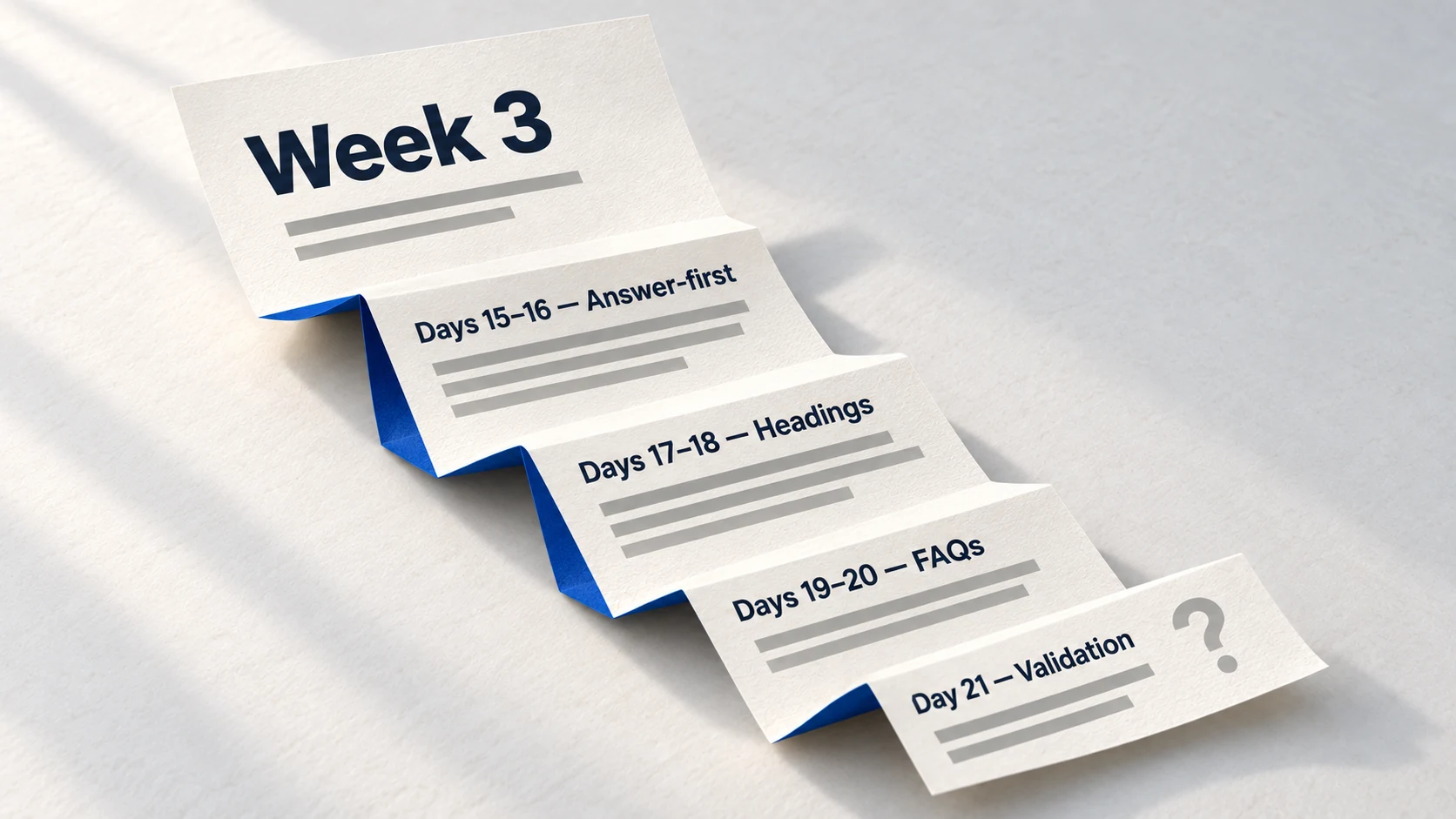
Week 3 transforms your content from traditional blog format to AI-ready structure. Days 15-16 implement answer-first formatting in your opening paragraphs. Days 17-18 optimize heading hierarchies for AI extraction. Days 19-20 add FAQ sections with proper schema. Day 21 validates the transformation. Focus on 5-10 priority pages-depth of transformation beats breadth of coverage.
Your entity foundation is solid. AI platforms know who you are. Now give them content worth citing.
The content you've already written is probably good. The problem isn't what you're saying-it's how you're saying it. AI platforms prefer specific structures: direct answers upfront, clear heading hierarchies, explicit FAQ sections. Content that buries the answer in paragraph four rarely gets cited, no matter how comprehensive it is.
Week 3 is about transformation, not creation. You're taking existing pages and restructuring them for AI extraction. By Day 21, your priority pages will be formatted the way AI platforms prefer-and citations will follow.
72.4%
of AI-cited content has answer capsules
Answer-first formatting is the single strongest predictor of AI citations.
Source: Search Engine Land →87%
of ChatGPT-cited pages have single H1
Clean heading structure signals content organization that AI can easily extract.
Source: AirOps →3.2x
AI Overview rate with FAQ schema
FAQ sections with proper schema dramatically increase AI feature eligibility.
Source: Frase.io →Why Content Structure Matters More Than Content Quality
Here's an uncomfortable truth: AI platforms don't read content the way humans do. They scan for extractable answers. They look for clear structural signals. They prefer content that can be chunked and quoted directly. Great writing buried in walls of text loses to mediocre writing formatted for extraction.
Definition
Answer-First Content
Content structured to deliver the key answer in the first 100 words, followed by supporting detail and context. The opposite of traditional blog structure (intro → buildup → answer). AI platforms prefer direct answers they can extract without parsing long introductions.
Think of AI platforms as extremely impatient readers. They need the answer immediately. If it's not in the first paragraph, they move on. Content that says "in this article we'll explore..." before getting to the point fails this test. Content that leads with the answer passes.
Content Structure Transformation
What You Need for Week 3
- ✓ 5-10 priority pages identified from Week 1 audit
- ✓ Access to edit your content (CMS or file access)
- ✓ The questions your content currently answers (often implied, not explicit)
- ✓ FAQPage schema template (provided below)
- ✓ Google Rich Results Test for schema validation
- ✓ Completed Week 2 entity foundation
Days 15-16: Answer-First Transformation
Answer-first transformation is the highest-impact change you can make. Move your key insight from wherever it currently lives (usually paragraph 3-5) to the very first paragraph. This single change dramatically increases citation probability.
Answer-First Transformation Process
- 1
Identify Key Answer
What's the ONE thing a reader needs to know? Find where you currently say it.
- 2
Create Answer Capsule
Write a 40-60 word direct answer. No hedging, no 'it depends.'
- 3
Move to First Paragraph
Place answer capsule as first paragraph. Delete the old introduction.
- 4
Restructure Remaining
Reorganize remaining content as supporting detail, not build-up.
Before/After: Answer-First Transformation
| Element | Before (Traditional) | After (AI-Optimized) |
|---|---|---|
| First paragraph | 'In this article, we'll explore the importance of...' | 'The best CRM for small businesses is [Name] because...' |
| Answer location | Paragraph 4-5, after intro and context | Paragraph 1, immediately visible |
| Word count before answer | 300-500 words | 0 words |
| AI extraction | Requires parsing long text | Direct extraction possible |
Answer Capsule Formula
What it does: This formula creates the extractable answer unit that AI platforms look for. Use it to rewrite your opening paragraph on each priority page.
Your input: Identify the core question your page answers and your definitive answer. No hedging-pick a stance.
Expected output: A 40-60 word opening paragraph that AI can extract and cite directly.
What to do next: Apply this formula to each of your 5-10 priority pages. The rest of your content stays-just restructure it as supporting detail.
Answer capsule formula:
[Direct answer to the question] + [One key supporting fact] + [Brief context or qualifier]

Example question: "What is GEO?"
Answer capsule: "GEO (Generative Engine Optimization) is the practice of optimizing content to appear in AI-generated answers from platforms like ChatGPT and Perplexity. Unlike traditional SEO which targets Google rankings, GEO focuses on citation by AI systems that synthesize information rather than linking to sources."

Word count: 52 words
Structure: Definition + Distinction from SEO + Key difference
35%
higher AI snippet inclusion
Pages with paragraph-length summaries at the top have significantly higher inclusion in AI-generated snippets. The answer capsule is that summary.
Source: Search Engine LandPro Tip
The answer capsule should be quotable in isolation. Read it out loud-if it makes complete sense without any other context, you've written it correctly. If someone needs to read the preceding paragraph to understand it, rewrite.
Days 17-18: Heading Structure Optimization
AI platforms use heading structure to understand content organization. A clear H1 → H2 → H3 hierarchy signals well-organized content they can parse. Random heading levels, skipped levels, or multiple H1s confuse the extraction process.
How to Read This Diagram: This funnel shows how heading structure affects AI extraction. Each level of structure increases the percentage of content AI can successfully extract and cite. Pages with poor structure lose at the first filter.
Heading Structure Impact on AI Extraction
87%
Pages with single H1
Single topic focus = clear extraction target
68.7%
Sequential H2→H3 structure
Logical hierarchy = parseable sections
45%
H2s as question headings
Query-matching = direct answer delivery
~25%
Successfully cited by AI
Structure + authority + answer = citation
Heading Structure Requirements
| Rule | Why It Matters | How to Implement |
|---|---|---|
| Single H1 | Defines page topic clearly | One H1 per page-your main title only |
| Sequential hierarchy | Shows logical content organization | H1 → H2 → H3, never skip levels |
| H2s as sections | Creates extractable content chunks | Each H2 = one complete subtopic |
| Question-format H2s | Matches how users query AI | 'What is X?' not 'About X' |
"68.7% of ChatGPT-cited pages have sequential heading structure (H1→H2→H3), compared to just 23.9% of random Google SERP pages. The structure difference is dramatic."
Pro Tip
Convert your H2 headings to questions when possible. 'Understanding GEO' becomes 'What Is GEO?' This mirrors how users query AI platforms and increases direct answer matching.
Days 19-20: FAQ Section Implementation
FAQ sections serve two purposes: they create additional answer capsules AI can extract, and with proper schema, they signal explicit question-answer pairs that AI platforms prioritize. Days 19-20 add FAQ sections to your priority pages with proper FAQPage schema.
FAQ Section Implementation
- 1
Extract Questions
Find questions your content already answers (they're there, just not explicit)
- 2
Write Concise Answers
40-80 words per answer, direct and complete
- 3
Add FAQ Section
Place at bottom of content with clear 'Frequently Asked Questions' heading
- 4
Implement Schema
Add FAQPage JSON-LD to signal structure to AI platforms
How to Use This Decision Guide: Not every page needs an FAQ section. Use this guide to determine which pages benefit most. Answer "yes" to the question that best describes your page, then follow the recommendation.
Question
Does this page need an FAQ section?
YES - add 4-6 FAQs about common mistakes, alternatives, and time requirements
YES - add 5-8 FAQs covering related concepts and comparisons
YES - add 4-5 FAQs about pricing, requirements, and outcomes
NO - FAQ doesn't fit; focus on answer-first formatting instead
FAQPage Schema Template
What it does: FAQPage schema explicitly tells AI platforms "here are question-answer pairs." Pages with this schema are 3.2x more likely to appear in AI Overviews.
Your input: Replace the example questions and answers with your actual FAQ content. Keep answers concise (40-100 words each).
Expected output: Google Rich Results Test shows FAQ rich result eligibility. AI platforms can directly extract question-answer pairs.
What to do next: Add this schema to each page with an FAQ section. Validate with Rich Results Test before moving on.
Copy this FAQPage schema template:
<script type="application/ld+json">
{
  "@context": "https://schema.org",
  "@type": "FAQPage",
  "mainEntity": [
    {
      "@type": "Question",
      "name": "[YOUR QUESTION 1]",
      "acceptedAnswer": {
        "@type": "Answer",
        "text": "[YOUR ANSWER 1 - 40-100 words]"
      }
    },
    {
      "@type": "Question",
      "name": "[YOUR QUESTION 2]",
      "acceptedAnswer": {
        "@type": "Answer",
        "text": "[YOUR ANSWER 2 - 40-100 words]"
      }
    }
  ]
}
</script>
3.2x
AI Overview appearance rate
Pages with FAQ schema and structured FAQ sections are dramatically more likely to appear in Google AI Overviews. The explicit question-answer format matches how AI systems deliver information.
Source: Frase.ioDay 21: Content Structure Validation
Day 21 validates your Week 3 work. Check each priority page against the transformation criteria. Validate FAQ schema. Confirm heading structure. This is quality control before moving to Week 4's off-site authority building.
Page-Level Validation Checklist
| Check | Pass Criteria | Fail Action |
|---|---|---|
| Answer capsule present | 40-60 words in first paragraph, direct answer | Rewrite opening paragraph with formula |
| Single H1 | One H1, matches page title/topic | Remove duplicate H1s, consolidate |
| Sequential headings | H1→H2→H3, no skipped levels | Fix hierarchy, add missing levels |
| FAQ section (if applicable) | 4-8 questions, 40-100 word answers | Add questions extracted from content |
| FAQ schema valid | Rich Results Test shows no errors | Fix JSON-LD syntax errors |
Pro Tip
Read your transformed pages out loud. If the first paragraph answers the question completely without needing context, you've done it right. If you need to say 'but first...' before getting to the answer, restructure.
Which Pages to Transform First
Not all pages need immediate transformation. Focus on pages with the highest citation potential-those that answer common questions in your expertise area, have existing authority signals, and target topics where AI platforms are actively synthesizing answers.
Page Priority Criteria
| Factor | High Priority | Lower Priority |
|---|---|---|
| Content type | How-to guides, explainers, comparisons | News, portfolios, case studies |
| Current traffic | Already ranks or gets organic traffic | No visibility, no authority signals |
| Topic competition | Questions actively asked on AI platforms | Niche topics AI rarely covers |
| Update frequency | Evergreen content, stable answers | Frequently changing, time-sensitive |
Warning
Check AI platforms directly. Query ChatGPT with questions your content answers. If competitors appear and you don't, that page is high priority. If nobody appears (the topic is too niche for AI coverage), deprioritize that page.
Week 3 Completion Checklist
Before moving to Week 4, confirm all Week 3 transformations are complete. Each priority page should pass all validation criteria.
Week 3 Deliverables
| Deliverable | Target | Validation Method |
|---|---|---|
| Pages transformed | 5-10 priority pages | Checklist review each page |
| Answer capsules | 40-60 words, first paragraph | Read aloud-standalone clarity test |
| Heading structure | Single H1, sequential H2→H3 | HTML inspection or CMS view |
| FAQ sections | 4-8 Qs on applicable pages | Visual check + answer length |
| FAQ schema | FAQPage JSON-LD, no errors | Google Rich Results Test |
FAQ
How many pages should I transform in Week 3?
What if my content already ranks well on Google?
Should I rewrite content completely or just restructure it?
How long should my answer capsule be?
Do I need FAQ sections on every page?
How quickly will structure changes affect AI citations?
Ready for Week 4?
Your entity foundation is solid. Your content is structured for AI extraction. Week 4 builds the off-site authority signals that complete the citation picture.
Week 4 focuses on directory listings, profile optimization, and strategic third-party mentions.
Take the GEO Readiness Quiz →60 seconds · Personalized report · Free
Continue Learning
Dive deeper into AI search with these related articles:
Your First ChatGPT Citation in 30 Days: Quick-Start GEO Guide
A week-by-week implementation plan to achieve your first AI citation. From visibility audit to schema markup to content optimization—the complete 30-day GEO quick-start guide.
Week 2: Foundation Building - Entity and Schema Basics
The complete Week 2 implementation guide for GEO foundation building. Day-by-day instructions for Organization schema, Person schema, About page optimization, and NAP consistency.
Answer-First Writing: How to Structure Content AI Wants to Cite
72.4% of AI-cited blog posts use answer capsules. Learn the answer-first writing structure.