GEO & AI Search
Your First ChatGPT Citation in 30 Days: Quick-Start GEO Guide
Quick Answer
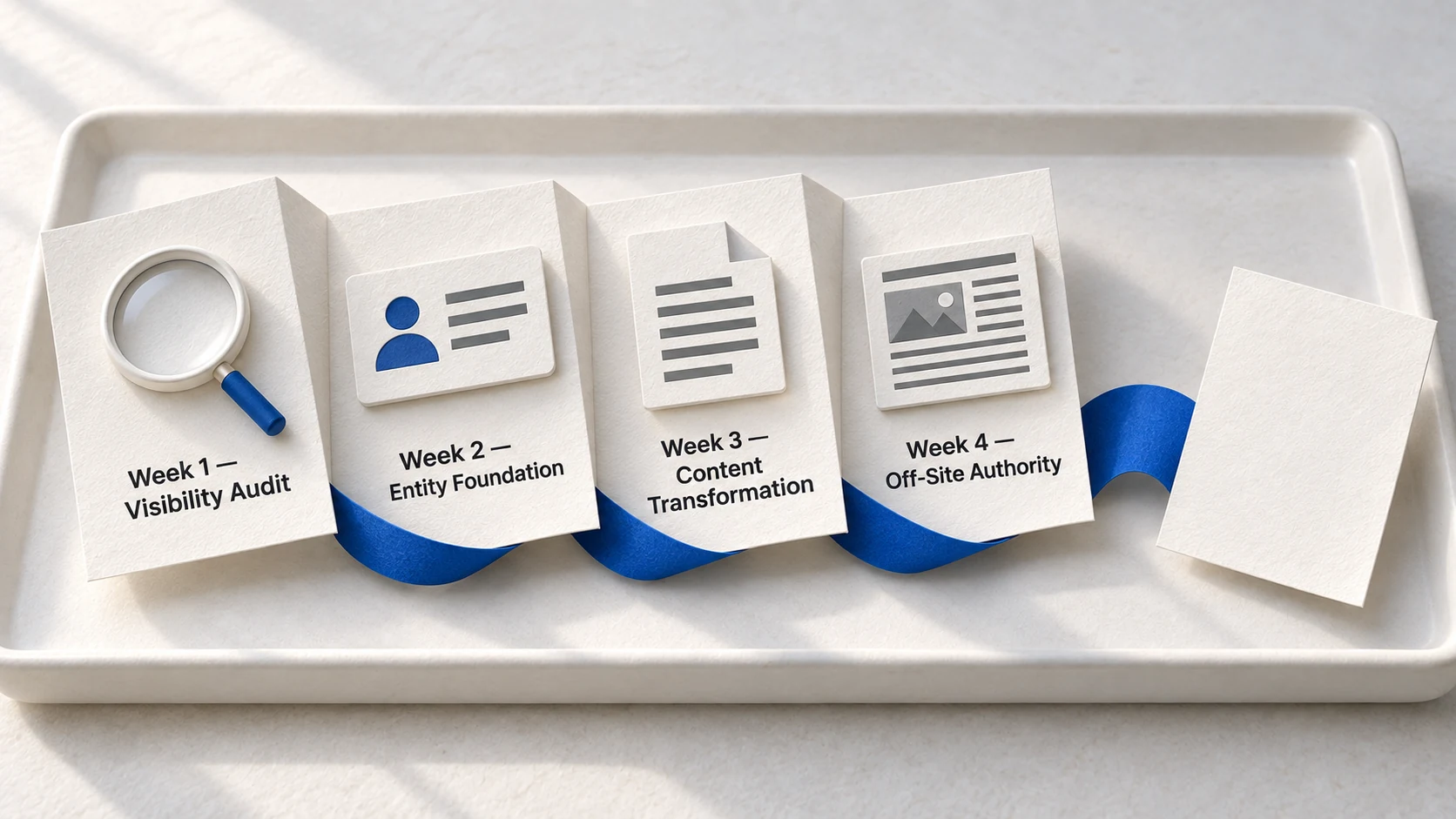
Getting your first ChatGPT citation takes 30 days of focused work across four phases: Week 1 audits your current AI visibility and identifies gaps. Week 2 builds your entity foundation with schema markup and About page optimization. Week 3 transforms your content into answer-first format that AI prefers. Week 4 builds off-site authority signals through strategic mentions and directory listings. This guide provides the exact implementation steps-no theory, just action.
30 days from now, you could have your first ChatGPT citation. Not someday. Not eventually. 30 days.
Most GEO guides give you theory. "Build authority." "Create structured content." "Establish entity signals." Fine-but what do you actually DO on Monday morning? What's the specific sequence of actions that leads from invisible to cited?
This guide is different. It's a 30-day implementation plan with specific tasks for each week. By Day 30, you'll have built the complete GEO foundation. The citations will follow. Let's start.
86%
of AI citations come from brand-managed sources
Your website and profiles are the primary citation sources-not third-party sites you can't control.
Source: Yext →72.4%
of AI-cited content has answer capsules
Answer-first formatting dramatically increases your chances of being cited by AI platforms.
Source: Search Engine Land →60-90
days to see optimization results
GEO changes typically show in AI responses within 60-90 days for existing pages with authority.
Source: Foundation Inc →Why 30 Days? The GEO Implementation Reality
GEO implementation isn't instant, but it's not months-long either. 30 days provides enough time to complete the foundational work without losing momentum. It's the sweet spot between rushed implementation and endless planning.
Definition
30-Day GEO Sprint
A focused implementation period where you complete the essential GEO foundations: visibility audit, entity establishment, content optimization, and authority signal building. The goal isn't perfection-it's getting the core infrastructure in place so AI platforms can discover and cite your content.
The 30-day timeline works because it matches how GEO actually functions. AI platforms index content in waves. Schema markup gets processed within 1-2 weeks. Content changes take 2-4 weeks to reflect in AI responses. Authority signals accumulate over time. Starting all four tracks simultaneously means they mature together around Week 8-12-when citations start appearing.
How to Use This Timeline: Bookmark this as your weekly reference. Each milestone shows what you're building and when it typically starts affecting AI visibility. The work you do in Week 1 won't show results until Week 4-8-this timeline helps you stay patient and focused when progress feels invisible.
The 30-Day Implementation Timeline
Visibility Audit
Assess current AI presence, identify gaps, establish baseline metrics
Entity Foundation
Schema markup, About page, author credentials, NAP consistency
Content Transformation
Answer-first formatting, heading optimization, FAQ sections
Authority Building
Directory listings, profile optimization, strategic mentions
- Week 1
Visibility Audit
Assess current AI presence, identify gaps, establish baseline metrics
- Week 2
Entity Foundation
Schema markup, About page, author credentials, NAP consistency
- Week 3
Content Transformation
Answer-first formatting, heading optimization, FAQ sections
- Week 4
Authority Building
Directory listings, profile optimization, strategic mentions
"GEO improvements typically show in 60-90 days for existing content with authority. The 30-day sprint builds the infrastructure-the citations come in the weeks that follow."
Before You Start: Prerequisites and Mindset
Not everyone is ready for a 30-day GEO sprint. Some prerequisites are technical (Google Analytics access), others are strategic (at least some existing content to optimize). Here's what you need before Day 1.
What You Need Before Starting
- ✓ A website with at least 10-20 pages of content
- ✓ Google Analytics 4 access (editor role or higher)
- ✓ Google Search Console access
- ✓ Ability to edit website HTML (or WordPress admin access)
- ✓ 4-6 hours per week to dedicate to implementation
- ✓ Basic familiarity with SEO concepts (optional)
- ✓ Access to ChatGPT/Perplexity for testing (optional)
Mindset matters too. GEO isn't a quick fix. You're building infrastructure that will pay off over months and years. The 30-day sprint creates the foundation-but results compound over time. If you're looking for overnight rankings, this isn't the right approach. If you're willing to invest 30 days for long-term visibility, keep reading.
Mindset Shift: SEO vs GEO Thinking
Week 1: The Visibility Audit
Week 1 is about discovery, not action. Before optimizing, you need to know where you stand. What AI platforms already know about you. Where you appear. Where you're invisible. The audit establishes your baseline and identifies exactly what needs work.
2-7
domains cited per AI response
AI platforms cite only 2-7 sources per answer. If you're not in that small set, you're invisible-regardless of how good your content is.
Source: TryProfoundWeek 1 Daily Tasks
- 1
Day 1-2
Query AI platforms with 15-20 keywords in your niche. Log where you appear.
- 2
Day 3
Set up GA4 AI Traffic channel to track AI referrals (10-minute task).
- 3
Day 4
Audit your About page, author bios, and entity signals.
- 4
Day 5
Check schema markup using Google's Rich Results Test.
- 5
Day 6-7
Document gaps and prioritize Week 2-4 tasks based on findings.
The AI Visibility Query Test
What it does: Tests whether AI platforms know about your brand and content. You'll query ChatGPT, Perplexity, and Claude with questions in your expertise area and log whether you appear in responses.
Your input: 15-20 questions your target audience asks. Include: "What is [topic]?", "Best [solution] for [problem]", "How to [task]", "[Your brand] reviews".
Expected output: A spreadsheet showing: Query | ChatGPT (Yes/No) | Perplexity (Yes/No) | Claude (Yes/No) | Competitors Mentioned.
What to do next: Calculate your baseline Citation Frequency (mentions ÷ queries × 100). This becomes your benchmark. Queries where competitors appear but you don't are your priority optimization targets.
Warning
Don't skip the baseline measurement. Without it, you won't know if your optimization is working. Even if your current Citation Frequency is 0%, that's valuable data-it tells you exactly how much you need to build.
Week 2: Building Your Entity Foundation
Week 2 is the most technical part of the sprint-but also the most foundational. AI platforms need to understand who you are before they'll cite you. Entity establishment tells AI: "This is a real business/person, here are the credentials, this is authoritative."
The three pillars of entity foundation: Organization/Person schema markup, a comprehensive About page (your "Entity Home"), and consistent NAP (Name, Address, Phone) across all platforms.
Score yourself on each item before starting Week 2. Rate each element: 1 = Not Started, 3 = Partial (exists but incomplete), 5 = Complete. Your total score reveals where to focus-items scoring 1 or 3 become your Week 2 priorities.
Entity Foundation Scorecard
| Factor | Not Started | Partial | Complete |
|---|---|---|---|
| Organization Schema | ●○○○○ | ●●●○○ | ●●●●● |
| Person Schema (Authors) | ●○○○○ | ●●●○○ | ●●●●● |
| About Page Optimization | ●○○○○ | ●●●○○ | ●●●●● |
| Author Bio Pages | ●○○○○ | ●●●○○ | ●●●●● |
| NAP Consistency | ●○○○○ | ●●●○○ | ●●●●● |
| sameAs Links (Social) | ●○○○○ | ●●●○○ | ●●●●● |
How to Use This Schedule: Block time on your calendar for each task. Days 8-9 are the most technical (schema)-if you need developer help, schedule it now. Day 14 is your validation checkpoint: don't proceed to Week 3 until all Week 2 items pass verification.
Week 2 Implementation Schedule
Day 8-9
Schema Markup
Implement Organization schema on homepage, Person schema on author pages. Use JSON-LD format.
Day 10
About Page Overhaul
Transform About page into Entity Home: founding story, credentials, team bios, contact info.
Day 11
Author Optimization
Create or enhance author bio pages with credentials, expertise, published works, social links.
Day 12-13
NAP Audit
Check business name, address, phone consistency across Google Business Profile, social profiles, directories.
Day 14
Validation
Test all schema with Rich Results Test. Verify About page loads completely. Check all social links.
Minimal Organization Schema Template
What it does: Tells AI platforms and search engines the basic facts about your organization-who you are, what you do, where to find you.
Your input: Replace the placeholder values with your actual company information.
Expected output: Valid JSON-LD that passes Google's Rich Results Test.
What to do next: Add this script to your homepage's <head> section. Then validate using Google's Rich Results Test.
Copy this Organization Schema:
<script type="application/ld+json">
{
  "@context": "https://schema.org",
  "@type": "Organization",
  "name": "Your Company Name",
  "url": "https://yourwebsite.com",
  "logo": "https://yourwebsite.com/logo.png",
  "description": "Brief description of what you do",
  "foundingDate": "2020",
  "sameAs": [
    "https://linkedin.com/company/yourcompany",
    "https://twitter.com/yourcompany"
  ],
  "contactPoint": {
    "@type": "ContactPoint",
    "email": "[email protected]",
    "contactType": "customer service"
  }
}
</script>
67%
citation reduction from NAP inconsistency
Inconsistent business information across platforms confuses AI systems and dramatically reduces your citation probability.
Source: BirdeyeWeek 3: Content Transformation
Week 3 is where most GEO impact happens. You'll transform existing content from traditional blog format into answer-first structure that AI platforms prefer. This isn't about creating new content-it's about making your existing content citable.
The key insight: AI platforms extract information from the first 500-1000 characters of a page. If your answer is buried in paragraph 4, AI won't find it. Answer-first formatting puts your expertise where AI can discover it.
Content Transformation: Before vs After
| Element | Traditional Format | Answer-First Format |
|---|---|---|
| Opening | Long introduction explaining why topic matters | Direct answer in first 100 words |
| Structure | Flowing prose paragraphs | Clear H2/H3 hierarchy with scannable sections |
| Questions | Questions scattered throughout | FAQ section with structured Q&A |
| Data Points | Stats embedded in text | Stats highlighted with sources |
| Author | Byline at top or bottom | Author expertise integrated into content |
Week 3 Content Optimization Process
- 1
Select Pages
Choose 5-10 high-value pages from audit. Prioritize pages on topics where competitors get cited.
- 2
Add Answer Capsules
Write 100-150 character direct answers. Place immediately after H1 or intro.
- 3
Restructure Headings
Create clear H2 hierarchy. Each H2 should be a question your audience asks.
- 4
Add FAQ Section
4-6 questions with concise answers. Use FAQPage schema markup.
- 5
Enhance Author Signals
Add author byline with credentials. Link to author bio page.
What the Research Shows: These percentages reveal how common each content element is among AI-cited pages. If 72% of AI-cited content has answer capsules, that's a strong signal-pages without them are fighting an uphill battle. Use this data to prioritize your Week 3 optimization work.
72.4% of AI-cited content has identifiable answer capsules
Source: Search Engine Land
68.7% of ChatGPT-cited pages have proper H1 → H2 → H3 structure
Source: AirOps Research
79% of ChatGPT-cited pages use HTML lists (vs 28.6% of Google SERP)
Source: AirOps Research
Pro Tip
Start with your 5 most important pages-the ones driving the most traffic or conversions. Perfect optimization on 5 pages beats mediocre optimization on 50. You can expand after Day 30.
Week 4: Off-Site Authority Signals
Week 4 extends your GEO work beyond your website. AI platforms don't just look at your site-they verify your claims against the broader web. Directory listings, profile consistency, and strategic mentions all contribute to your AI credibility.
42%
of AI citations reference directory listings
Yelp, LinkedIn, industry directories-these third-party sources appear in nearly half of AI citations. Being listed matters.
Source: YextHow to Use This Schedule: Work through each task in order. Days 22-25 are about establishing presence; Days 26-28 are about building social proof. Day 29-30 is critical-this is when you measure progress against your Week 1 baseline.
Week 4 Authority Building Schedule
Day 22-23
Directory Audit
Check presence on top 20 directories for your industry. Claim unclaimed profiles. Update outdated information.
Day 24-25
Profile Optimization
Optimize LinkedIn company page, Google Business Profile, industry-specific directories with consistent messaging.
Day 26
Social Proof
Request reviews on key platforms. Respond to existing reviews. Add testimonials to website.
Day 27-28
Strategic Mentions
Identify guest posting or media opportunities. Submit to relevant HARO queries. Comment on industry discussions.
Day 29-30
Final Audit
Re-run visibility test from Week 1. Document improvements. Create ongoing maintenance plan.
Directory Priority Tiers
| Tier | Platforms | Priority |
|---|---|---|
| Tier 1 (Essential) | Google Business Profile, LinkedIn, Yelp, industry's #1 directory | Complete immediately |
| Tier 2 (Important) | Facebook, Twitter/X, YouTube, Crunchbase, industry directories #2-5 | Complete within Week 4 |
| Tier 3 (Nice to Have) | Smaller niche directories, review sites, podcast appearances | Ongoing after Day 30 |
Warning
Foursquare powers 60-70% of ChatGPT's local data. If you're a local business, Foursquare listing is non-negotiable. Check and update it during Week 4 even if you've never used the platform directly.
Measuring Your Progress
You can't improve what you don't measure. Throughout the 30-day sprint, track these key indicators to verify your work is having impact.
Weekly Metrics
- → Citation Frequency: Re-run query test weekly. Track changes.
- → AI Referral Traffic: Check GA4 AI Traffic channel.
- → Schema Validation: Confirm no errors in Rich Results Test.
Day 30 Assessment
- → Baseline Comparison: Citation Frequency Day 1 vs Day 30.
- → Implementation Checklist: All tasks completed?
- → Forward Plan: What's the Week 5-8 maintenance plan?
GA4 AI Traffic Channel Setup
What it does: Creates a dedicated channel in GA4 that shows traffic from ChatGPT, Perplexity, Claude, and other AI platforms separately from generic referral traffic.
Your input: GA4 Admin access. Navigate to Data Display → Channel Groups → Create New.
Expected output: A new "AI Traffic" row in your Traffic Acquisition reports.
What to do next: Wait 24-48 hours for data. Then check Reports → Acquisition → Traffic Acquisition and select your new channel group.
AI Traffic Regex Pattern:
chatgpt\.com|claude\.ai|perplexity\.ai|gemini\.google\.com|copilot\.microsoft\.com
What Happens After Day 30
Day 30 isn't the end-it's the beginning. You've built the foundation. Now comes maintenance and expansion. Here's what the next 60 days look like.
How to Plan Your Post-Sprint Work: Add these milestones to your calendar now. The 30-day sprint created infrastructure; the next 60 days reveal whether it's working. Don't evaluate results until Day 60-90-AI visibility improvements take time to appear.
Post-Sprint Timeline
Days 31-45
Monitor & Iterate
Watch for first citations. Identify which pages get cited, which don't. Refine based on data.
Days 46-60
Expand Content
Apply answer-first format to next 10 pages. Create new content targeting gaps identified in audit.
Days 61-90
Build Authority
Pursue guest posting opportunities. Submit to HARO. Build backlinks to optimized content.
Ongoing
Maintain & Grow
Monthly citation monitoring. Quarterly content refresh. Continuous entity building.
Expected results timeline: Most sites see first citations 60-90 days after optimization for pages with existing authority. New content takes 90-180 days. Traffic impact follows citations by 30-60 days. Don't evaluate at Day 30-evaluate at Day 90.
"GEO ROI follows a J-curve: initial investment with negative returns, followed by accelerating positive returns as visibility compounds. Organizations that evaluate too early often kill programs right before they become profitable."
Common Obstacles and How to Overcome Them
Every 30-day sprint hits obstacles. Technical issues, time constraints, unclear priorities. Here's how to handle the most common blockers.
Common Obstacles and Solutions
| Obstacle | Why It Happens | Solution |
|---|---|---|
| Can't add schema markup | CMS restrictions, no dev access | Use WordPress plugins (Yoast, RankMath) or Google Tag Manager injection |
| Not enough time | Underestimated effort | Focus on Week 2 (schema) + Week 3 (5 pages). Defer Week 4 to Days 31-45 |
| No citations after Day 30 | Normal-results take 60-90 days | Continue monitoring. Focus on content quality. Don't panic. |
| Competitor already dominates | Competitive niche | Target long-tail queries first. Build authority before attacking head terms. |
| Content quality too low | Thin content, no expertise | Improve content first. GEO can't fix bad content-it surfaces good content. |
Pro Tip
If you can only do ONE thing from this guide, do Week 2's schema markup. Entity establishment is the foundation everything else builds on. Without it, content optimization and authority building have limited impact.
FAQ
Is 30 days really enough to get a ChatGPT citation?
Do I need technical skills to implement this plan?
What if I'm already doing SEO-can I skip some steps?
Should I focus on one AI platform or all of them?
How do I know if my optimization is working?
What's the minimum time investment per week?
Ready to Get Started?
You now have the complete 30-day framework. The audit, the foundations, the content work, the authority building-everything you need to earn your first AI citation.
Start with Week 1's visibility audit. By Day 30, you'll have implemented the essential GEO infrastructure. The citations will follow.
Take the GEO Readiness Quiz →60 seconds · Personalized report · Free
Continue Learning
Dive deeper into AI search with these related articles:
Week 1: GEO Audit - Assessing Your Current AI Visibility
The complete Week 1 implementation guide for your GEO audit. Test platform visibility, calculate citation frequency baseline, check entity signals, and identify gaps.
The Complete Schema Markup Guide for GEO
Master schema markup for AI visibility. Essential types, implementation strategy, and common mistakes.
Entity Optimization Masterclass: AI Brand Recognition
Master the complete framework for establishing your brand as a recognized entity in AI systems. From Entity Homes to Wikidata to knowledge panels.