GEO & AI Search
ChatGPT for GEO: The Essential Prompts
Quick Answer
ChatGPT itself is a powerful GEO optimization tool-when you use the right prompts. This guide provides 10 ready-to-use prompts across five categories: content auditing, optimization, competitor analysis, entity building, and tracking. Each prompt is designed to produce actionable outputs, not vague advice. Copy, paste, customize with your content, and get specific recommendations for improving AI search visibility.
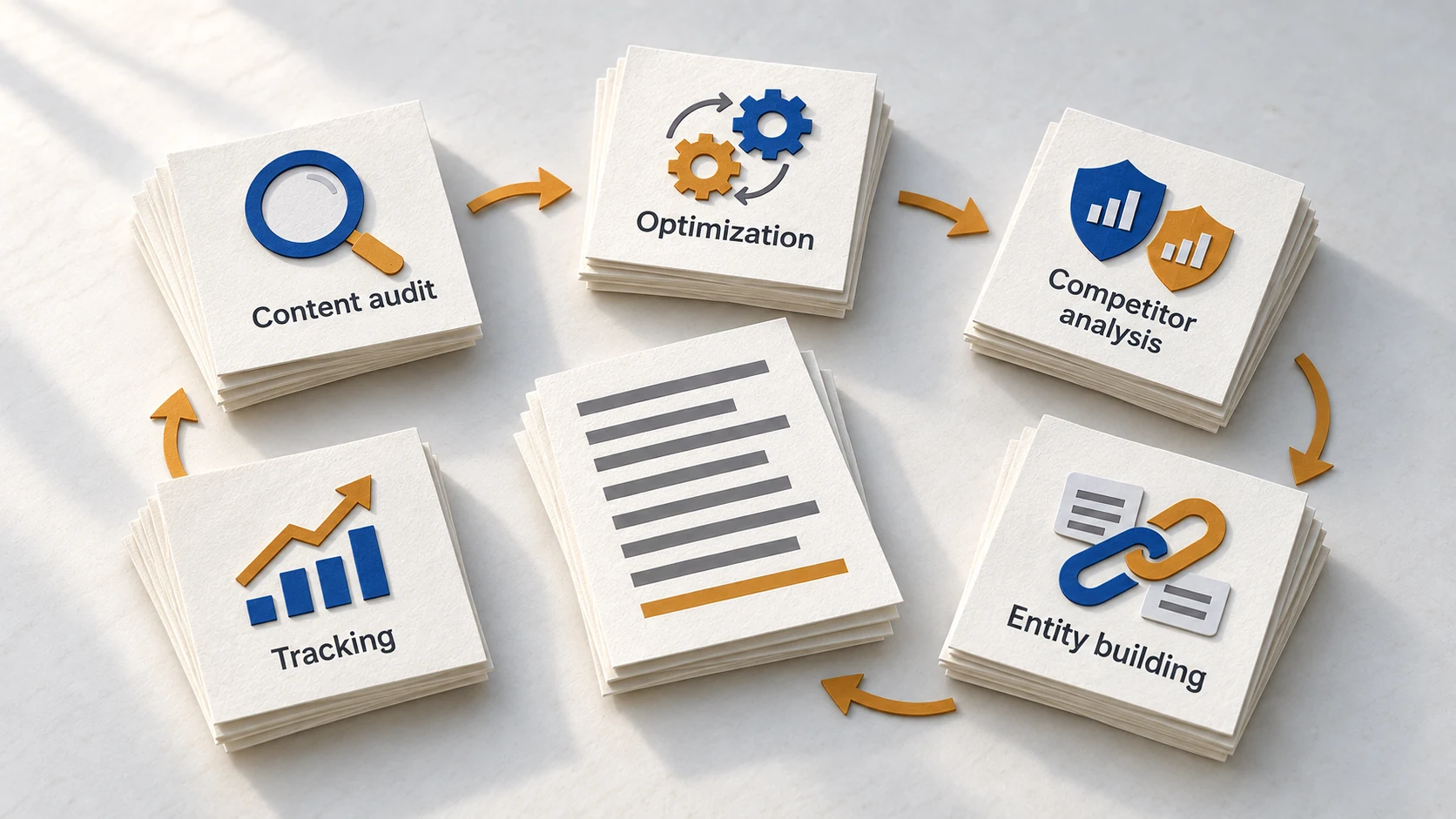
You've read about GEO optimization. You understand the principles-answer-first structure, entity signals, semantic clarity. But when you sit down to actually optimize your content, you're staring at a blank ChatGPT window with no idea what to type.
The irony: the same AI platform you're trying to get cited by can help you optimize for citations. ChatGPT can audit your content structure, identify missing entity signals, analyze how competitors get cited, and suggest specific improvements. You just need the right prompts.
This guide provides copy-paste prompts for every stage of GEO optimization. Each prompt is designed for immediate use-no customization required beyond pasting your own content. Let's turn ChatGPT into your GEO optimization partner.
48%
of ChatGPT citations from Wikipedia
Structure your content like encyclopedia entries for better citation rates.
Source: TryProfound →30-50
words for ideal answer capsules
Tight enough to quote cleanly, comprehensive enough to be useful.
Source: Superprompt →90 days
recommended content refresh cycle
AI models evolve-content that gets cited today may need updates.
Source: DeepakNess →Content Audit Prompts: Assess Your Current GEO Readiness
Before optimizing, understand where your content stands. These prompts analyze structure, identify gaps, and score your current GEO readiness.
Prompt 1: GEO Readiness Audit
What it does: This prompt gives you a clear score (1-25) across five GEO dimensions-so you know exactly where your content stands and what to fix first. Think of it as a diagnostic report, not vague advice.
Your input: One complete content piece. Works for blog posts, landing pages, product pages, or any content you want AI to cite.
Expected output: A structured scorecard with five dimension ratings, the specific issue in each area, one concrete fix per dimension, and your overall GEO readiness score.
What to do next: If you score below 15, focus on the fixes before investing in promotion. Score 15-20 means you're in good shape but have room to grow. Above 20? Your content is optimized-move on to tracking.
Copy this prompt:
You are a GEO (Generative Engine Optimization) expert. Analyze the following content for AI citation potential.

Evaluate these 5 dimensions (score 1-5 each):
1. Answer-First Structure: Does the content lead with clear, quotable answers?
2. Semantic Clarity: Are key concepts defined explicitly without ambiguity?
3. Entity Signals: Are brand/author/topic entities clearly established?
4. Evidence Quality: Are claims backed with specific data, sources, or examples?
5. Extractability: Can AI easily pull standalone passages that make sense out of context?

For each dimension:
- Score 1-5
- Identify the specific issue
- Provide one concrete fix

End with an overall GEO Readiness Score (sum of all scores, out of 25) and the single highest-impact improvement.

Content to analyze:
[PASTE YOUR CONTENT HERE]
Prompt 2: Answer Capsule Detection
What it does: AI engines quote specific passages, not entire articles. This prompt finds your existing quotable passages and-more importantly-reveals where you're missing them entirely. It's like having an editor highlight exactly what AI can extract.
Your input: Content with clear section headings. The more sections, the more useful the analysis. Works best with 3+ distinct sections.
Expected output: A section-by-section breakdown showing your existing capsules (quoted exactly), quality ratings (Strong/Weak/Missing), and rewritten versions for anything that needs improvement.
What to do next: For any section rated "Missing," use the improved version the AI suggests as your new opening. For "Weak" sections, edit to remove context dependencies-make each answer stand alone.
Copy this prompt:
Analyze the following content for "answer capsules"-self-contained passages of 30-50 words that directly answer a question and could be quoted by an AI without additional context.

For each section:
1. Identify any existing answer capsules (quote them exactly)
2. Rate capsule quality: Strong (clear, standalone, factual), Weak (needs context), Missing (no capsule present)
3. If Missing or Weak, write an improved answer capsule that could replace the opening

Format output as:
---
Section: [section heading]
Existing Capsule: [quote or "None found"]
Quality: [Strong/Weak/Missing]
Improved Version: [if needed]
---

Content to analyze:
[PASTE YOUR CONTENT HERE]
Pro Tip
Run the GEO Readiness Audit on your top 5 organic traffic pages first. These already rank on Google-optimizing them for AI citations multiplies existing visibility rather than starting from scratch.
Optimization Prompts: Improve Content for AI Citations
Once you've identified gaps, these prompts help you rewrite and restructure content for better AI extraction. Each produces publish-ready output.
"Structure content in a way that is easy for LLMs to extract as a direct response, using bullet points, numbered lists, and headers for clarity."
Prompt 3: Full GEO Optimization
What it does: This is the heavy-duty rewrite prompt. It restructures your entire piece for AI extraction-adding answer capsules, fixing semantic clarity, weaving in entity signals-while keeping your voice intact. The output is publish-ready, not a list of suggestions.
Your input: Your complete original content. The AI needs context about topic and audience, so include those details if they're not obvious from the content itself.
Expected output: A fully rewritten version of your content with answer-first formatting, embedded entity signals, semantic richness, and authority markers. Ready to copy-paste and publish.
What to do next: Read through the optimized version to ensure it still sounds like you. The AI maintains tone, but check for any voice drift. Then compare with your original-you'll likely spot patterns you can apply to future content.
Copy this prompt:
You are an expert in Generative Engine Optimization (GEO)-optimizing content to be referenced by LLMs like ChatGPT, Claude, Gemini, and Perplexity.

Take the following content and optimize it for AI citations. Apply these enhancements:

1. CONTEXTUAL RELEVANCE
- Add clear signals about who this is for and what problem it solves
- Embed real-world use cases or questions the content answers

2. ANSWER-STYLE FORMATTING
- Structure for easy LLM extraction using bullets, lists, headers
- Lead each section with a 30-50 word answer capsule
- Break complex ideas into numbered steps

3. SEMANTIC RICHNESS
- Match natural language patterns users employ when asking about this topic
- Include related keywords LLMs associate with the subject

4. TOPICAL AUTHORITY SIGNALS
- Incorporate specific data points with sources
- Add trust-building language demonstrating unique expertise

5. NATURAL BRAND INTEGRATION
- Weave brand mentions naturally as reputable options (not promotional)

Output ONLY the optimized content-no explanations. Make it publish-ready.

Original content:
[PASTE YOUR CONTENT HERE]
Prompt 4: Opening Paragraph Rewrite
What it does: Your content might be excellent-but the opening buries the answer. This targeted prompt rewrites just the first paragraph to lead with what AI can quote. Surgical fix, not a full overhaul.
Your input: Your current opening paragraph and a brief description of what the article covers. The AI needs topic context to write a relevant answer-first opening.
Expected output: A single rewritten paragraph (30-50 words) that answers the main question directly, includes one supporting fact, and stands alone as a quotable passage.
What to do next: Replace your current opening with the new version. Then check if the transition to your second paragraph still flows-you may need to adjust one connecting sentence.
Copy this prompt:
Rewrite ONLY the opening paragraph of this content. The new opening must:

1. Answer the main question in 1-2 clear sentences (30-50 words max)
2. Include one specific data point or fact
3. Be self-contained-usable as a standalone quote
4. Avoid questions, setup, or context that delays the answer

Keep my original voice and tone. Output only the rewritten paragraph.

Original opening and article topic:
[PASTE OPENING + DESCRIBE TOPIC]
Opening Paragraph Transformation
Competitor Analysis Prompts: Learn from AI-Cited Content
Analyze what's already getting cited to reverse-engineer success patterns. These prompts help you understand why competitors appear in AI answers.
Prompt 5: Citation Pattern Analysis
What it does: Your competitor keeps appearing in AI answers. Why? This prompt reverse-engineers their content to reveal exactly what makes it citation-worthy-structure, authority signals, quotable passages-so you can apply the same patterns.
Your input: Content from a competitor that AI currently cites for your topic. Copy the full text from their page-the AI needs to see what's actually working.
Expected output: A breakdown of their structural patterns, authority signals, answer density, and-critically-the gaps they're not covering that you could exploit.
What to do next: Focus on the "Gaps I Can Exploit" section. Create content that covers what they miss with better structure. You're not copying-you're outflanking.
Copy this prompt:
I'm going to share content from a source that AI frequently cites for [YOUR TOPIC]. Analyze why this content gets cited by identifying:

1. STRUCTURE PATTERNS
- How is the content organized?
- Where do quotable passages appear?
- What formatting makes extraction easy?

2. AUTHORITY SIGNALS
- What credentials or expertise markers are present?
- How are sources and data integrated?
- What language builds trust?

3. ANSWER DENSITY
- How many standalone answer capsules exist?
- What's the ratio of context to direct answers?
- Where are the most quotable passages?

4. GAPS I CAN EXPLOIT
- What questions does this NOT answer well?
- What perspectives are missing?
- What newer data could I provide?

Competitor content:
[PASTE COMPETITOR CONTENT]
Prompt 6: AI Citation Query Testing
What it does: You can't optimize for queries you don't know exist. This prompt generates the actual questions people type into ChatGPT, Perplexity, and Claude about your topic-organized by intent type so you know which ones to target first.
Your input: Your topic and target audience. Be specific-"B2B SaaS onboarding" gives better results than just "software."
Expected output: 15 queries split into informational, comparative, and actionable categories. Each query includes the search intent and whether your current content covers it.
What to do next: Actually test these queries in ChatGPT and Perplexity. Note who gets cited. Use Prompt 5 to analyze their content. This turns theoretical optimization into real competitive intelligence.
Copy this prompt:
Generate 15 questions that users likely ask AI assistants about [YOUR TOPIC].

Organize into three categories:

INFORMATIONAL (5 queries)
- "What is..." and "How does..." questions
- Basic understanding queries

COMPARATIVE (5 queries)
- "Which is better..." and "What's the difference..." questions
- Decision-making queries

ACTIONABLE (5 queries)
- "How do I..." and "What should I..." questions
- Implementation-focused queries

For each query, note:
- Search intent (learn/compare/do)
- Content type most likely to be cited (definition/comparison/guide)
- My current coverage (have/partial/missing)

Topic: [YOUR TOPIC]
Pro Tip
Use Prompt 6 to generate queries, then actually test them in ChatGPT and Perplexity. Note who gets cited and analyze their content with Prompt 5. This gives you a real-world competitive map, not theoretical assumptions.
Entity & Authority Prompts: Strengthen Brand Signals
AI engines need to understand who you are before they'll recommend you. These prompts help establish and strengthen entity signals.
Key Insight: This statistic reveals where AI engines actually look when forming recommendations-your own controlled properties matter far more than third-party mentions.
86%
of AI citations from brand-managed sources
AI engines trust content you control-your website, verified profiles, and consistent brand information across platforms.
Source: Yext 6.8M Citation StudyPrompt 7: Entity Consistency Audit
What it does: AI engines cross-reference information across sources. If your LinkedIn says "Founded 2019" and your website says "Since 2018," that inconsistency erodes trust. This prompt finds every discrepancy so you can fix them before they cost you citations.
Your input: Copy and paste content from 3-4 sources: your website About page, LinkedIn profile, Google Business Profile, and any industry directories where you're listed.
Expected output: A list of every discrepancy found-with the conflicting quotes side by side and a recommended "canonical" version to use everywhere.
What to do next: Update all sources to match the canonical versions. Start with the sources AI references most: your website, LinkedIn, and Google Business Profile. Consistency compounds over time.
Copy this prompt:
I'll share information about my brand from multiple sources. Identify inconsistencies that could confuse AI engines about who we are.

Check for discrepancies in:
1. Company/person name variations
2. Founding date/establishment year
3. Location/headquarters
4. Service descriptions
5. Key credentials/achievements
6. Social profile URLs
7. Contact information

For each inconsistency found:
- Quote the conflicting information
- Identify which source is correct
- Suggest the canonical version to use everywhere

Source 1 (Website About Page):
[PASTE]

Source 2 (LinkedIn):
[PASTE]

Source 3 (Google Business Profile):
[PASTE]

Source 4 (Industry Directory):
[PASTE]
Prompt 8: Author Authority Bio
What it does: Generic bios ("John is passionate about marketing") don't build AI trust. This prompt creates a bio designed for entity recognition-specific credentials, measurable achievements, and connections to verifiable entities that AI can cross-reference.
Your input: Your name, current role, years of experience, credentials/certifications, measurable achievements (with numbers), company affiliations, and any publications or speaking engagements.
Expected output: A 100-150 word bio in third person, factual tone. Heavy on specifics, light on fluff. Includes "sameAs-worthy" mentions-entities AI can verify independently.
What to do next: Use this bio consistently across all platforms: your website, LinkedIn, guest posts, podcast appearances. Every repetition reinforces your entity signals.
Copy this prompt:
Write an author bio optimized for AI trust signals. The bio should:

1. Establish expertise with specific credentials (not vague claims)
2. Include measurable achievements (numbers, timeframes)
3. Connect to verifiable entities (companies, publications, institutions)
4. Be structured for easy extraction (clear sentences, no complex clauses)
5. Include sameAs-worthy mentions (LinkedIn, publications, verified profiles)

Length: 100-150 words
Tone: Professional, factual, third-person

Author information:
- Name: [YOUR NAME]
- Role: [CURRENT ROLE]
- Experience: [YEARS AND AREAS]
- Credentials: [DEGREES, CERTIFICATIONS]
- Achievements: [MEASURABLE RESULTS]
- Companies: [CURRENT AND PAST]
- Publications/Speaking: [IF ANY]
Tracking Prompts: Monitor Your AI Visibility
These prompts help you systematically check your AI visibility and document changes over time. Run them weekly or monthly for ongoing monitoring.
Prompt 9: Visibility Test Protocol
What it does: Sporadic testing tells you nothing. This prompt creates a structured protocol-specific queries to test, platforms to check, and a schedule to follow-so you can track AI visibility systematically over time.
Your input: Your brand or topic name and a description of your target audience. The more specific your audience description, the more relevant the test queries.
Expected output: 10 test queries (5 informational, 5 comparative), a testing template for ChatGPT/Perplexity/Claude, and a weekly tracking schedule-all formatted as a markdown table you can copy to a spreadsheet.
What to do next: Run the first round of tests immediately to establish a baseline. Then follow the weekly schedule. Patterns emerge after 4-6 weeks of consistent tracking.
Copy this prompt:
Create a visibility testing protocol for tracking my brand's AI citations.

Brand/Topic: [YOUR BRAND OR TOPIC]
Target Audience: [WHO YOU SERVE]

Generate:

1. TEST QUERIES (10 total)
- 5 informational queries where my brand SHOULD appear
- 5 comparative queries where I compete with alternatives

2. TESTING TEMPLATE
For each platform (ChatGPT, Perplexity, Claude):
- Query text
- Date tested
- Was brand mentioned? (Yes/No/Partial)
- Context of mention (positive/neutral/negative)
- Competitors mentioned instead
- Source link if provided

3. TRACKING SCHEDULE
- Which queries to test weekly vs monthly
- When to re-audit based on results
- Triggers for content updates

Output as a markdown table I can copy to my tracking spreadsheet.
Prompt 10: Citation Change Analysis
What it does: Your citations dropped. Or spiked. Either way, you need to understand why. This prompt analyzes before/after data to identify the most likely cause-so you can fix problems or replicate wins.
Your input: Your before and after citation data from tracking: which queries you were cited for, how often, and in what context. The more detail you provide, the sharper the analysis.
Expected output: A root cause analysis considering content changes, competitor activity, AI model updates, authority signal shifts, and query pattern changes. Plus a recommended action based on whether visibility went up or down.
What to do next: If visibility dropped, implement the recommended fix and re-test in 2 weeks. If visibility increased, document what worked and apply the same pattern to other content.
Copy this prompt:
Analyze why my AI citation visibility changed between these two periods.

BEFORE (describe previous state):
- Queries I was cited for: [LIST]
- Approximate citation frequency: [DAILY/WEEKLY/RARELY]
- Typical citation context: [HOW I WAS MENTIONED]

AFTER (describe current state):
- Queries I'm now cited for: [LIST - MORE OR FEWER?]
- Approximate citation frequency: [CHANGE?]
- Typical citation context: [ANY SHIFT?]

Consider these factors:
1. Did I publish new content or update existing?
2. Did competitors publish competing content?
3. Did AI models update (affecting citation patterns)?
4. Did my authority signals change (new links, mentions)?
5. Did query patterns shift (seasonal, trend-based)?

Provide:
- Most likely cause of change
- Recommended action (if visibility dropped)
- Opportunity to exploit (if visibility increased)
How to Use This Schedule: Consistency beats intensity for GEO monitoring. This five-day rotation covers all platforms without overwhelming your week. Adjust the specific days to fit your workflow-the important thing is maintaining the pattern weekly.
Weekly GEO Monitoring Schedule
💡 Run 5 test queries in ChatGPT, note citations
💡 Run same queries in Perplexity, compare results
💡 Document any new competitor citations
💡 Review GA4 for AI referral traffic patterns
💡 Update tracking spreadsheet, flag pages needing optimization
✨ Save this template for consistent formatting across all platforms
FAQ
Can I use ChatGPT to optimize content for ChatGPT citations?
How often should I run GEO audit prompts?
What's the best ChatGPT model for GEO optimization prompts?
Should I use the same prompts for all AI platforms?
How long should my content be for AI citations?
Can I automate these prompts?
Ready to Optimize Your Content for AI?
These prompts give you the framework. The real work is applying insights consistently and tracking what actually gets cited.
Start with the content audit prompt on your highest-traffic page.
Take the GEO Readiness Quiz →60 seconds · Personalized report · Free
Continue Learning
Dive deeper into AI search with these related articles:
The AI Toolkit You Actually Need: Cutting Through GEO Tool Overwhelm
62% of marketers use more tools than 2 years ago. Here's the focused GEO toolkit that delivers results: free tools to start, paid tools worth the investment, and exactly how to choose what you need.
Answer-First Writing: How to Structure Content AI Wants to Cite
72.4% of AI-cited blog posts use answer capsules. Learn the answer-first writing structure.
AI Citation Frequency: What It Is and How to Track It
Citation frequency measures how often AI models reference your content. Learn what it is and how to track it.