GEO & AI Search
Review Strategy for Local AI Visibility
Quick Answer
Review optimization for AI visibility requires consistent response to all reviews, strategic platform prioritization, and steady review velocity. Research shows 88% of consumers would use a business that responds to both positive and negative reviews-compared to just 47% for non-responders. AI engines analyze review sentiment, response quality, and recency to assess business trustworthiness. ChatGPT sources 27% of local results from business mentions (including reviews), while positive sentiment lifts AI click-through by 38%. The strategy: respond to every review within 48 hours, prioritize Google then industry platforms, maintain monthly review flow, and handle negative reviews professionally.
You've been collecting reviews for years. Five stars here, four stars there. A handful of "Great service!" comments. Maybe a few negative ones you'd rather forget.
But here's what changed: those reviews aren't just for humans anymore. Every time someone asks ChatGPT "best plumber in Austin" or Perplexity "top-rated HVAC contractor near me," AI engines scan your review content to decide whether you're worth recommending. They're reading the actual words your customers wrote-and how you responded.
This guide covers how AI engines actually process review content, which platforms matter most, and the specific tactics that turn reviews into AI recommendations. No vague advice-just actionable strategies you can implement this week.
88%
would use businesses that respond to reviews
vs. 47% for non-responders-a 41-point trust advantage.
Source: BrightLocal →38%
higher clicks from positive AI mentions
Review sentiment directly affects AI recommendation engagement.
Source: Relixir →27%
of ChatGPT local results from business mentions
Reviews and customer mentions are a primary AI data source.
Source: BrightLocal →How AI Engines Actually Read Your Reviews
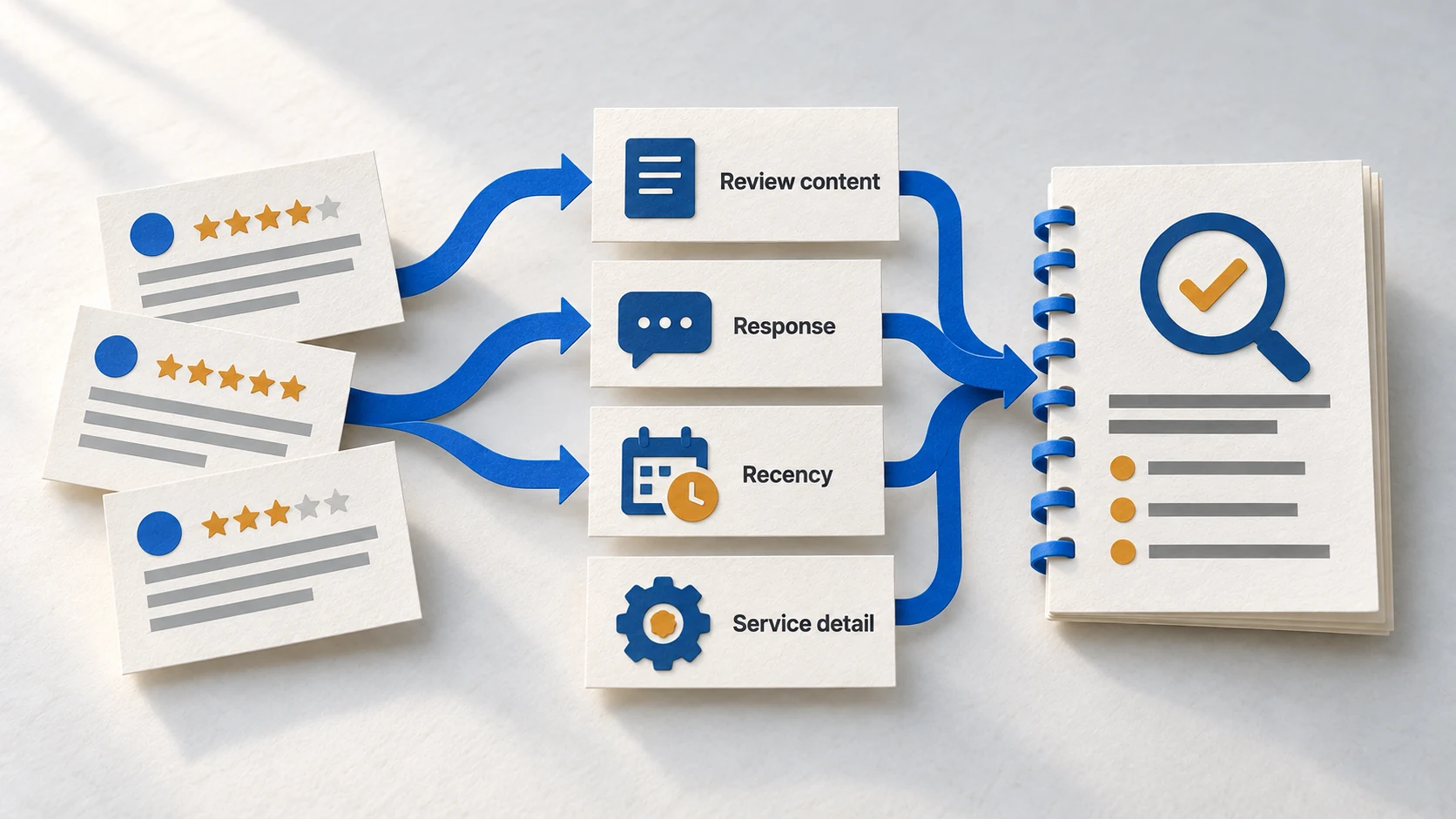
AI engines don't just count stars. They perform sentiment analysis on review text, extract specific service mentions, evaluate response quality, and assess recency patterns. Understanding this process reveals exactly what to optimize.
When someone asks ChatGPT for a local business recommendation, here's what happens behind the scenes. The AI doesn't just check your average rating-it reads your reviews like a hiring manager reads references:
Review Factors That Influence AI Recommendations
| Category | Relative Weight (%) |
|---|---|
| Sentiment Quality | 30 |
| Response Rate | 25 |
| Review Recency | 20 |
| Service Specificity | 15 |
| Volume/Velocity | 10 |
Source: Compiled from BrightLocal, Birdeye, and HubSpot research 2024-2025
Notice that star rating isn't even on the chart. That's because AI engines read the actual content. A 4-star review with specific praise ("Fixed our water heater in 2 hours, explained everything clearly") is more valuable than a 5-star review that just says "Great!"
"AI platforms like ChatGPT and Perplexity now drive up to 12% of website traffic, worth $750 billion in revenue potential by 2028. Positive mentions lift clicks by 38%, while negative prompts erode factual accuracy and coverage."
This is why generic "Thanks for your feedback!" responses hurt you. AI engines detect pattern repetition. They score personalized, specific responses higher than templated ones because engagement quality signals business reliability.
Review Response Strategy: The 88% vs 47% Split
The single biggest trust signal in reviews isn't the reviews themselves-it's how you respond. BrightLocal research reveals a 41-point gap between businesses that respond and those that don't.
88%
vs 47%
The trust difference between businesses that respond to all reviews and those that don't respond at all. This 41-point gap directly affects AI recommendations.
Source: BrightLocal 2024The gap is clear-but what makes a response effective for AI? It's not just replying. It's how you reply. The comparison below shows the difference between a response AI ignores and one that signals genuine customer engagement:
Review Response Comparison
The personalized response does several things the generic one doesn't: it references specific services (water heater installation), mentions concrete details (2-hour response time, same-day service), uses the customer's name, and anticipates future business (annual maintenance). AI engines extract all of this as service quality signals.
Review Response Templates by Review Type
| Review Type | Response Strategy | Key Elements to Include |
|---|---|---|
| 5-Star Positive | Express gratitude, reference specifics, invite return | Customer name, specific service mentioned, next step invitation |
| 4-Star Good | Thank, address any concerns briefly, highlight what went well | Acknowledge the positive, explain any limitations, offer improvement |
| 3-Star Mixed | Appreciate honesty, address concerns directly, offer resolution | Specific issue acknowledgment, solution or next step, direct contact option |
| 1-2 Star Negative | Empathize first, take responsibility, offer offline resolution | No defensiveness, genuine apology, direct contact for follow-up |
Warning
Never respond to negative reviews defensively. AI engines analyze sentiment in your responses too. A calm, professional response to criticism actually builds more trust than the criticism erodes. The response matters more than the review itself.
Platform Priority Framework: Where to Focus First
Not all review platforms carry equal weight with AI engines. Different AI tools pull from different sources, and your industry affects which platforms matter most. Here's how to prioritize.
The scorecard below rates each platform on three factors: how often AI engines cite it, how much consumer trust it carries, and how relevant it is across industries. Google dominates, but industry platforms punch above their weight for specialized queries:
Review Platform Priority for AI Visibility
| Factor | AI Citation Rate | Consumer Trust | Cross-Industry Relevance |
|---|---|---|---|
| Google Reviews | ●●●●● | ●●●●● | ●●●●● |
| Yelp | ●●●●○ | ●●●●○ | ●●●●○ |
| ●●●○○ | ●●●●○ | ●●●●○ | |
| Industry-Specific (Healthgrades, Avvo, Houzz) | ●●●●○ | ●●●●● | ●●○○○ |
| TripAdvisor | ●●●○○ | ●●●●○ | ●●○○○ |
| BBB | ●●●○○ | ●●●●○ | ●●●○○ |
Why does Google dominate? Two reasons: integration with AI Overviews (40.2% of local searches) and cross-platform data sharing. ChatGPT and Perplexity don't directly access Google reviews, but they access Foursquare data (which aggregates from Google) and business websites (which often display Google reviews).
Platform Priority by Industry
Home Services (HVAC, Plumbing, Electrical)
- 1. Google Business Profile
- 2. Yelp
- 3. Angi / HomeAdvisor
- 4. BBB
Healthcare (Doctors, Dentists, Specialists)
- 1. Google Business Profile
- 2. Healthgrades
- 3. Zocdoc
- 4. Vitals
Legal (Attorneys, Law Firms)
- 1. Google Business Profile
- 2. Avvo
- 3. Martindale-Hubbell
- 4. Yelp
Restaurants & Hospitality
- 1. Google Business Profile
- 2. Yelp
- 3. TripAdvisor
- 4. OpenTable
Review Velocity: The Freshness Signal AI Monitors
AI engines prefer businesses with recent activity. A steady stream of new reviews signals an active, thriving business. A dormant review profile-even with high ratings-signals potential issues.
Think of review velocity like a heartbeat monitor. The pattern matters as much as the numbers. Steady beats = healthy business. Flatline = concerning signal, even if historical data looked good:
Healthy Velocity Pattern
- + 5-10 new reviews monthly (consistent)
- + Mix of platforms (Google primary)
- + Varied ratings (all 5-stars looks fake)
- + Responses within 48 hours
- + Reviews mention specific services
Warning Signs AI Detects
- × No reviews in 6+ months
- × Sudden burst after long silence
- × All reviews on same day/week
- × No owner responses anywhere
- × Generic, similar-sounding reviews
Proactive Review Generation: Ethical Tactics That Work
You can-and should-ask for reviews. The key is doing it ethically, at the right time, and making the process frictionless. Here are the tactics that generate consistent review flow without violating platform policies.
Review Request Framework
1. In-Person Ask (Highest Conversion)
At the point of service, when satisfaction is confirmed.
"I'm glad we could get your AC running before the weekend. If you have 30 seconds, a quick Google review really helps other people find us. I can text you the link right now."
2. Follow-Up Email (24-48 Hours)
Automated but personalized, with direct link.
"Hi [Name], thanks for choosing us for your [specific service] yesterday. If you have a moment, sharing your experience on Google helps us reach more homeowners like you. [Direct Link Button]"
3. Invoice/Receipt Insert
QR code on physical receipts, digital link in invoices.
"Your feedback matters. Scan to share your experience on Google." [QR Code]
4. Text Message (Same Day)
Brief, direct, one tap to review page.
"Thanks for choosing [Business]! A quick review helps us help others: [Short Link]"
Warning
Never offer incentives for reviews-this violates Google, Yelp, and most platform policies. If discovered, you risk losing all your reviews. Instead, make the ask easy, time it right, and provide excellent service that naturally generates positive feedback.
Managing Negative Reviews for AI Perception
Negative reviews happen. What matters for AI visibility is how you handle them. A professional response to criticism often builds more trust than the criticism erodes-AI engines evaluate your response quality, not just the negative feedback.
The Negative Review Response Formula
Acknowledge
Thank them for the feedback. Don't dismiss their experience.
Empathize
Show you understand their frustration. No defensiveness.
Address
Briefly explain what happened or what you'll do differently.
Offline
Offer to continue the conversation privately.
Here's what a well-handled negative review looks like. Notice how the owner doesn't make excuses, takes responsibility, and moves the conversation offline while still addressing the public concern:
Customer Review (2 stars):
"Showed up 2 hours late and tracked mud through my house. Would not use again."
Owner Response:
"Thank you for your honest feedback, Sarah. I'm truly sorry our technician arrived late and didn't take proper precautions entering your home. That's not the experience we want for any customer. I've personally reviewed this visit with our team to ensure it doesn't happen again. I'd like to make this right-please reach out to me directly at [email] so we can discuss how to resolve this for you. - [Owner Name]"
This response accomplishes several things: it shows empathy ("I'm truly sorry"), takes responsibility ("our technician," not excuses), demonstrates action ("reviewed this visit"), and offers resolution without arguing publicly. AI engines reading this pattern recognize a customer-focused business.
Measuring Review Impact on AI Visibility
Tracking review impact requires monitoring both traditional metrics and AI-specific visibility. Here's how to measure whether your review strategy is working.
Review Health Dashboard
Weekly Metrics to Track
- → New reviews received (target: 3-5+)
- → Average rating trend (stable or improving)
- → Response rate (target: 100%)
- → Response time (target: under 48 hours)
- → Service mentions in reviews
Monthly AI Visibility Tests
- → Search "[service] + [city]" in ChatGPT
- → Search same query in Perplexity
- → Check Google AI Overview triggers
- → Note whether you're mentioned
- → Track changes month-over-month
FAQ
How do online reviews affect AI search visibility?
Which review platforms matter most for AI visibility?
How often should I respond to reviews?
Do negative reviews hurt AI visibility?
How many reviews do I need for AI visibility?
Should I ask customers for reviews?
Ready to Turn Reviews Into AI Recommendations?
Your reviews aren't just social proof anymore. They're the content AI engines scan before deciding whether to recommend you.
88% trust advantage with consistent review responses.
Take the GEO Readiness Quiz →60 seconds · Personalized report · Free
Continue Learning
Dive deeper into AI search with these related articles:
Local Business GEO: How Small Businesses Can Compete in AI Search
40.2% of local searches trigger AI Overviews. Learn the complete Local GEO framework: Google Business Profile optimization, LocalBusiness schema, NAP consistency, reviews, and hyperlocal content.
Google Business Profile Optimization for AI Search
Make your Google Business Profile the entity record AI engines verify and recommend. The complete GBP optimization checklist for AI search visibility.
E-E-A-T in the AI Era: How to Build Machine Trust
85% of AI-cited sources show strong E-E-A-T signals. Learn how to build Experience, Expertise, Authoritativeness, and Trust that AI engines recognize.