GEO & AI Search
Local Business GEO: How Small Businesses Can Compete in AI Search
Quick Answer
Local Business GEO combines Google Business Profile optimization, LocalBusiness schema markup, consistent NAP citations, strategic review management, and hyperlocal content to make small businesses visible in AI search. With 40.2% of local searches triggering AI Overviews and case studies like NoGood's SteelSeries campaign showing 23x year-over-year growth in AI traffic, local GEO is no longer optional. The framework prioritizes five pillars: entity establishment through GBP, structured data through schema, trust signals through citation consistency, social proof through reviews, and topical authority through neighborhood-level content.
Your Google rankings look fine. Your reviews are solid. Your website exists. But when someone asks ChatGPT for the best plumber in your city, or Siri for a nearby coffee shop, or Google for restaurants with outdoor seating-your business is invisible.
Meanwhile, your competitor down the street-the one with fewer reviews and a worse website-keeps appearing in every AI recommendation. The difference isn't luck. It's Local GEO: the art and science of making small businesses visible in AI search.
This guide is the comprehensive playbook. Everything you need to compete with well-funded chains and AI-savvy competitors-even if you've never heard of schema markup and your "marketing team" is you, after hours, with a cup of coffee.
40.2%
of local searches trigger Google AI Overviews
AI is already reshaping how customers find local businesses-not someday, but right now.
Source: Local Falcon →23x
increase in year-over-year AI traffic
NoGood agency's SteelSeries case study shows the massive growth potential when AI engines discover your business.
Source: NoGood (SteelSeries Case Study) →1.5B
"near me" searches happen every month
That's 50 million local searches every single day-and 76% of searchers visit a business within 24 hours.
Source: Backlinko →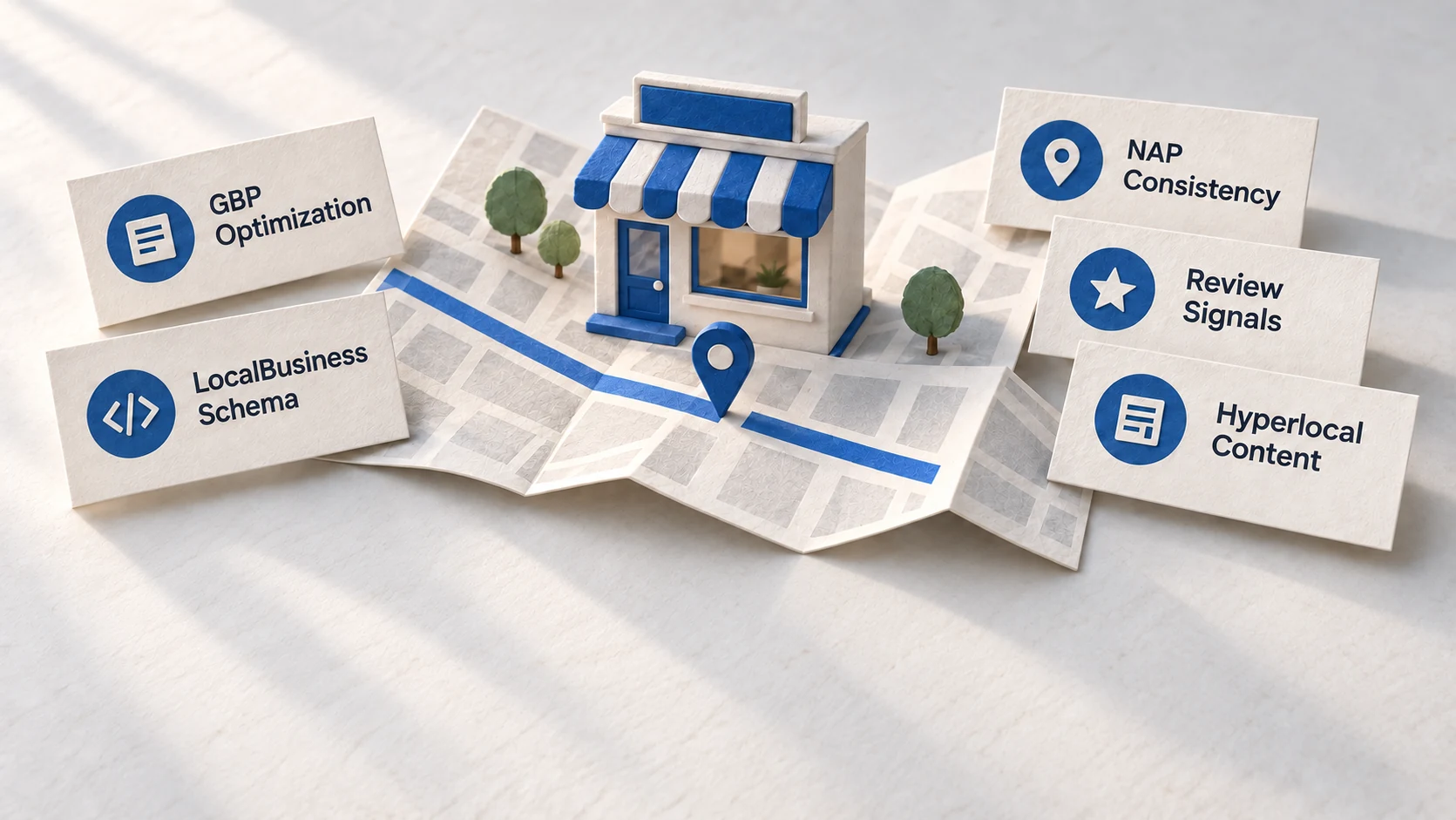
The Local Search AI Revolution: What Changed for Small Businesses
The way customers find local businesses has fundamentally shifted. Understanding this shift is essential before diving into tactics.
Definition
Local GEO (Local Generative Engine Optimization)
The practice of optimizing a local business's digital presence to appear in AI-powered search results-including Google AI Overviews, ChatGPT recommendations, Perplexity answers, and voice assistant responses. Unlike traditional local SEO which focused on map pack rankings, Local GEO prioritizes entity establishment, structured data, and cross-platform consistency that AI engines can verify and trust.
Three Fundamental Shifts in Local Search
From "10 Blue Links" to Synthesized Answers
Traditional local search showed you a list of options. AI search gives you a direct recommendation. When someone asks "best Italian restaurant downtown with outdoor seating," AI doesn't show 10 restaurants-it tells them which one to visit and why. Your business is either the answer or invisible.
From Single-Source to Multi-Platform Verification
Google used to be the only search engine that mattered. Now AI engines pull from Google Business Profile, Yelp, Foursquare, industry directories, and your website simultaneously. Inconsistency anywhere undermines trust everywhere. Birdeye research shows inconsistent NAP data reduces AI citation probability by 67%.
From Keywords to Entity Understanding
Stuffing "best pizza NYC" into your website isn't enough anymore. AI engines want to understand what your business is, what you offer, where you operate, and why you're credible. This requires structured data, consistent entity signals, and verifiable information across platforms.
Traditional SEO vs. Local GEO
Where AI Gets Local Data
- • Google Business Profile - Foundation for Google AI and many third-party AI tools
- • Yelp - Used in 33% of LLM local searches across all industries
- • Foursquare - Powers 60-70% of ChatGPT's local results
- • Industry directories - Specialized sources for healthcare, legal, hospitality
- • Your website - Appears as source 58% of time in ChatGPT local searches
Why Local Matters More in AI Search
- • 46% of all Google searches have local intent
- • 76% of "near me" searchers visit a business within 24 hours
- • 88% of smartphone local searchers visit or call within a day
- • Voice search is 76% local - "Hey Siri, find a..." triggers AI answers
- • 80% of local searches convert into customers
The competitive opportunity: Only 12.4% of websites have structured data, and most small businesses haven't optimized for AI at all. Early movers who implement Local GEO now will dominate AI visibility before competitors realize the game has changed.
The Local GEO Framework: 5 Pillars of AI Visibility
Local GEO success requires coordinated optimization across five interconnected pillars. Miss one and the others lose effectiveness. Nail all five and you create a reinforcing system that builds AI trust over time.
The 5 Pillars of Local GEO
Google Business Profile Optimization
Your GBP is the foundational entity record that AI engines reference first. A complete, actively maintained profile is far more likely to surface in AI Overviews than a bare listing. This pillar establishes who you are.
LocalBusiness Schema Markup
Schema helps AI understand your business type, location, hours, and services in machine-readable format. Properly implemented schema increases AI citation probability by 3.4x. This pillar speaks AI's language.
Citation Consistency (NAP)
Consistent Name, Address, Phone across all platforms creates the verification signal AI engines need. Inconsistent NAP reduces citation probability by 67%. This pillar builds trust through verification.
Review Signal Optimization
AI engines analyze review sentiment, not just star ratings. They read your responses and evaluate resolution quality. This pillar provides social proof that AI can cite.
Hyperlocal Content
Neighborhood-specific content establishes geographic authority beyond your address. Research shows hyperlocal content improves AI citation rates by 2.8-3.2x. This pillar demonstrates local expertise.
Most small businesses have barely started. Even partial implementation puts you ahead of 88% of competitors who haven't touched structured data or cross-platform optimization.
Google Business Profile: Your AI Search Foundation
Your Google Business Profile isn't just a directory listing-it's the primary entity record that Google's AI references when answering local queries. It also feeds data to many third-party AI platforms. Getting GBP right is non-negotiable.
42%
more AI Overview appearances for optimized GBP profiles
Businesses with fully optimized profiles significantly outperform basic listings in AI search visibility.
Source: All About AI →70%
more in-store visits for businesses with detailed GBP information
Comprehensive profiles don't just improve AI visibility-they directly drive foot traffic.
Source: Backlinko →The AI-Optimized GBP Checklist
Business Information (Foundation)
- ✓ Exact legal business name (no keyword stuffing)
- ✓ Complete street address with suite/unit numbers if applicable
- ✓ Local phone number (not toll-free-AI prefers local verification)
- ✓ Website URL linking to your homepage or relevant landing page
- ✓ Accurate business hours including special holiday hours
- ✓ Primary and secondary business categories (choose precisely)
Description & Services (AI Extraction Target)
- ✓ 750-character description mentioning location, services, and unique value
- ✓ All services listed with descriptions (AI extracts these for recommendations)
- ✓ Products catalog if applicable with accurate pricing
- ✓ Service area defined (for service-area businesses)
- ✓ Natural language, not keyword stuffing-AI detects spam
Visual Assets (Trust Signals)
- ✓ Logo image (clear, recognizable)
- ✓ Cover photo showing business exterior or signature product/service
- ✓ Interior photos (at least 5-10)
- ✓ Team photos (builds E-E-A-T signals)
- ✓ Product/service photos (what customers actually buy)
- ✓ Customer photos (with permission-social proof)
Engagement Features (Freshness Signals)
- ✓ Weekly posts (events, offers, updates)-AI loves freshness
- ✓ Q&A section populated with common customer questions
- ✓ Respond to every review within 24-48 hours
- ✓ Messages enabled and monitored
- ✓ Booking/appointment links if applicable
2025 GBP Attributes (New Signals)
- ✓ "Women-led" attribute if applicable (influences diversity-focused searches)
- ✓ "Eco-friendly" attribute if applicable (sustainability-focused queries)
- ✓ Accessibility attributes (wheelchair access, etc.)
- ✓ Payment methods accepted
- ✓ Health & safety attributes (if relevant to your industry)
Pro Tip
AI loves freshness. Businesses that post weekly updates, respond to reviews promptly, and update seasonal hours see significantly higher AI visibility. Set a recurring reminder to post every Monday-even a simple 'This week's special' keeps your profile active in AI's eyes.
The Description Formula That AI Extracts
Structure your GBP description so AI can easily extract and cite key information:
[Business name] is a [business type] serving [specific neighborhood/city] since [year]. We specialize in [primary service 1], [primary service 2], and [primary service 3]. [Unique value proposition or differentiator]. Located [location context-"in the heart of downtown" or "near [landmark]"].
Example: "North Star Plumbing is a licensed plumbing company serving San Francisco's Marina District since 2008. We specialize in emergency repairs, bathroom remodeling, and water heater installation. Our technicians arrive within 2 hours for emergencies-guaranteed. Located near Fort Mason, we serve Marina, Cow Hollow, and Pacific Heights."
LocalBusiness Schema: Speaking AI's Language
Schema markup is structured data that tells AI engines exactly what your business is, where it's located, when it's open, and what services you offer. Without schema, AI has to guess. With schema, you're speaking AI's native language.
3.4x
higher AI citation probability with proper schema
Schema removes ambiguity-AI engines don't have to interpret your content, they read your data.
Source: TryProfound →12.4%
of websites have structured data implemented
The competitive advantage is massive-87.6% of competitors aren't speaking AI's language at all.
Source: Frase.io →Definition
LocalBusiness Schema
A specific type of schema.org structured data markup that defines a local business's key properties-name, address, phone, hours, geo-coordinates, price range, and service offerings-in a machine-readable JSON-LD format. LocalBusiness schema has specialized subtypes for specific industries: Restaurant, Dentist, Plumber, RealEstateAgent, and many more. AI engines use this data to verify business information and generate accurate recommendations.
Essential LocalBusiness Schema Properties
These properties should be included in every LocalBusiness schema implementation:
| Property | Why It Matters for AI | Example |
|---|---|---|
| @type | Tells AI your specific business category | "Restaurant", "Plumber", "Dentist" |
| name | Exact business name for entity matching | "North Star Plumbing LLC" |
| address | Location verification and "near me" matching | Full PostalAddress object |
| geo | Precise coordinates for proximity calculations | latitude: 37.8024, longitude: -122.4058 |
| telephone | NAP consistency verification | "+1-415-555-0123" |
| openingHours | "Open now" queries and availability | "Mo-Fr 08:00-18:00" |
| priceRange | Budget-conscious recommendations | "$$" or "$50-$200" |
| areaServed | Critical for service-area businesses | "San Francisco Bay Area" |
| sameAs | Links entity across platforms (2-3x weighting) | Array of social/directory URLs |
| aggregateRating | Social proof for AI recommendations | ratingValue: 4.8, reviewCount: 127 |
LocalBusiness Schema Template
Copy and customize this JSON-LD template for your website. Place it in your homepage's <head> section.
LocalBusiness Schema Template (JSON-LD)
<script type="application/ld+json">
{
  "@context": "https://schema.org",
  "@type": "LocalBusiness",
  "@id": "https://yourwebsite.com/#localbusiness",
  "name": "Your Business Name",
  "description": "Brief description of your business and services",
  "url": "https://yourwebsite.com",
  "telephone": "+1-XXX-XXX-XXXX",
  "priceRange": "$$",
  "address": {
    "@type": "PostalAddress",
    "streetAddress": "123 Main Street",
    "addressLocality": "Your City",
    "addressRegion": "CA",
    "postalCode": "12345",
    "addressCountry": "US"
  },
  "geo": {
    "@type": "GeoCoordinates",
    "latitude": "37.XXXXXX",
    "longitude": "-122.XXXXXX"
  },
  "openingHoursSpecification": [
    {
      "@type": "OpeningHoursSpecification",
      "dayOfWeek": ["Monday", "Tuesday", "Wednesday", "Thursday", "Friday"],
      "opens": "09:00",
      "closes": "17:00"
    }
  ],
  "sameAs": [
    "https://www.facebook.com/yourbusiness",
    "https://www.yelp.com/biz/yourbusiness",
    "https://www.linkedin.com/company/yourbusiness"
  ],
  "aggregateRating": {
    "@type": "AggregateRating",
    "ratingValue": "4.8",
    "reviewCount": "127"
  }
}
</script>
Choose Your Schema Type
Question
Which LocalBusiness subtype should you use?
Use Restaurant, CafeOrCoffeeShop, or BarOrPub
for food/beverage businesses. Include menu, servesCuisine, and acceptsReservations properties.
Use ProfessionalService or specific subtypes
like Attorney, AccountingService. Include areaServed and knowsAbout properties.
Use HomeAndConstructionBusiness subtypes
like Plumber, Electrician, HVACBusiness. Critical to include areaServed for service territory.
Use MedicalBusiness subtypes
like Dentist, Physician, MedicalClinic. Include medicalSpecialty and availableService properties.
Use Store or specific subtypes
like ClothingStore, HardwareStore. Include paymentAccepted and currenciesAccepted properties.
Use LocalBusiness as the base type
This works for businesses that don't fit specialized categories.
Warning
Always validate your schema using Google's Rich Results Test (search.google.com/test/rich-results) before going live. Invalid schema is worse than no schema-it can confuse AI engines and reduce trust. After implementation, verify it renders correctly in Google Search Console's Enhancement reports.
Citation Consistency: The NAP Foundation
NAP-Name, Address, Phone-consistency is the most underrated factor in local GEO. AI engines cross-reference your business information across dozens of sources. When they find conflicts, they reduce trust and skip citations. When they find perfect consistency, they gain confidence in recommending you.
67%
reduction in AI citation probability from inconsistent NAP
A single address variation or phone format difference can tank your AI visibility.
Source: Birdeye →3.2x
higher AI platform visibility with consistent omnichannel data
Businesses with consistent information across all platforms dramatically outperform those with fragmented data.
Source: Conductor →The NAP Consistency Audit
Check these platforms for exact consistency. Even minor variations (St. vs Street, Suite 100 vs #100) can trigger trust issues:
Priority Tier 1 (Check First)
- ✓ Google Business Profile
- ✓ Your website (header, footer, contact page)
- ✓ Apple Maps
- ✓ Bing Places
- ✓ Yelp
- ✓ Facebook Business Page
Priority Tier 2 (ChatGPT Sources)
- ✓ Foursquare (powers 60-70% of ChatGPT local data)
- ✓ TripAdvisor
- ✓ MapQuest
- ✓ Yellow Pages
- ✓ Industry-specific directories
Priority Tier 3 (Social & Data Aggregators)
- ✓ LinkedIn Company Page
- ✓ Instagram Business Profile
- ✓ BBB (Better Business Bureau)
- ✓ Chamber of Commerce listings
- ✓ Data aggregators (Localeze, Factual, Infogroup)
Industry-Specific (If Applicable)
- ✓ Healthgrades, Zocdoc (healthcare)
- ✓ Avvo, FindLaw (legal)
- ✓ Houzz, Angi (home services)
- ✓ OpenTable, Zomato (restaurants)
- ✓ Zillow, Realtor.com (real estate)
Common NAP Inconsistencies That Kill AI Visibility
Name Variations
- ❌ "ABC Plumbing" vs "ABC Plumbing LLC" vs "ABC Plumbing, Inc."
- ❌ "The Coffee Shop" vs "Coffee Shop"
- ❌ Including or omitting "& Associates" inconsistently
Address Variations
- ❌ "Street" vs "St." vs "St"
- ❌ "Suite 100" vs "Ste 100" vs "#100" vs "Unit 100"
- ❌ Including or omitting zip code +4
Phone Variations
- ❌ "(415) 555-1234" vs "415-555-1234" vs "415.555.1234"
- ❌ Toll-free on some, local on others
- ❌ Old phone numbers never updated
The Fix
- ✓ Choose ONE exact format for each element
- ✓ Document it (business name, full address, phone format)
- ✓ Update all platforms to match exactly
Citation Management Tools
BrightLocal
Citation audit and building for 2-50 locations. Finds inconsistencies and tracks corrections across platforms. Starting at $39/month.
Learn more →Yext
Enterprise citation management for 50+ locations. Direct API connections to major directories for real-time updates. Enterprise pricing.
Learn more →Moz Local
Citation monitoring and distribution with analytics. Good for single-location businesses focused on data accuracy. Starting at $149/year.
Learn more →Whitespark
Citation building and local rank tracking. Specializes in finding and building high-quality local citations. Project-based pricing.
Learn more →Review Signals: Social Proof for AI Engines
Local SEO Research (2026)
Businesses with review profiles are 3x more likely to be cited by AI
Reviews aren't just for human customers anymore. AI search engines use review presence and review content as a strong authority signal-businesses without review profiles are essentially invisible to AI recommendation systems for local queries.
AI engines don't just count your reviews and average rating. They analyze review sentiment, read your responses, and evaluate how you handle complaints. Reviews are a conversation that AI observes-and uses to decide whether to recommend you.
How AI Engines Use Reviews
Sentiment Analysis
AI reads the actual text of reviews, not just star ratings. A 4-star review that says "Amazing food, slow service but worth the wait" provides more signal than a 5-star review that just says "Good." Reviews mentioning specific attributes (outdoor seating, kid-friendly, quick service) help AI match you to specific queries.
Response Quality
Your responses to reviews signal customer care quality. AI evaluates tone, empathy, and resolution-not just whether you responded. Generic responses like "Thanks for your feedback!" score lower than personalized responses that address specific concerns. AI can tell the difference.
Recency & Velocity
A business with 200 reviews from 2020 and nothing since looks inactive. AI prefers businesses with steady, recent review flow that signals ongoing customer activity. Aim for consistent new reviews rather than review-building sprints.
Platform Distribution
Reviews on Google matter most for Google AI, but Yelp reviews feed Yelp's AI data which multiple LLMs access. TripAdvisor, Facebook, and industry-specific platforms all contribute to the review signal AI engines synthesize.
Respond to All Reviews
Every review-positive or negative-deserves a response within 24-48 hours. AI sees non-response as disengagement.
Address Concerns Specifically
For negative reviews, acknowledge the issue, apologize, and offer resolution. AI reads resolution patterns.
Avoid AI-Generated Responses
Generic AI-written responses are detectable and counterproductive. Personalize every response.
Warning
Yelp is used as a source in 33% of all LLM local searches across industries. If you've been ignoring Yelp because you focus on Google, you're invisible to a third of AI queries. Claim and optimize your Yelp profile with the same care as your GBP.
Hyperlocal Content: Neighborhood-Level Authority
Your address tells AI where you're located. Hyperlocal content tells AI that you truly understand and serve your local area. It's the difference between "located in San Francisco" and "the trusted plumber for Marina District homeowners dealing with the neighborhood's aging Victorian pipes."
2.8-3.2x
higher AI citation rates with hyperlocal content
Content that demonstrates neighborhood expertise signals authority AI engines can cite.
Source: All About AI →76%
of voice searches have local intent
"Hey Siri, find a plumber near me" triggers AI answers-hyperlocal content helps you be that answer.
Source: Backlinko →Hyperlocal Content Types That Build AI Authority
Neighborhood Service Pages
Create dedicated pages for each neighborhood or area you serve. Include neighborhood-specific challenges, local references, and area-specific testimonials.
Example: "Plumbing Services in Marina District" that mentions "Victorian-era pipes common in Marina homes," "proximity to Fort Mason," and testimonials from Marina residents.
Local FAQ Content
Answer location-specific questions your customers actually ask. Use conversational phrasing that matches how people ask AI assistants.
Example: "How quickly can a plumber get to Pacific Heights?" "What are the most common plumbing issues in Cow Hollow's older homes?" "Do you service the Richmond District on weekends?"
Local Resource Content
Create content that demonstrates deep local knowledge beyond your immediate services.
Example for a restaurant: "Best Coffee Shops Within Walking Distance of [Your Restaurant]" or "A Local's Guide to Parking in [Your Neighborhood]"
Case Studies with Location Context
Document projects with specific neighborhood references that demonstrate local expertise.
Example: "How We Solved the Water Pressure Problems Common in Nob Hill's High-Rise Buildings" or "Full Bathroom Remodel in a Classic Mission District Victorian"
The Hyperlocal Content Formula
Each neighborhood page should include these AI-friendly elements:
- ✓ Neighborhood name in title and H1 - "Plumbing Services in [Neighborhood]"
- ✓ Local landmark references - "Near [park/school/landmark]"
- ✓ Neighborhood-specific challenges - "Common issues in [area]'s housing stock"
- ✓ Area-specific testimonials - Reviews from customers in that neighborhood
- ✓ Local FAQ section - Questions specific to that area
- ✓ Service-area schema - areaServed property for each neighborhood
- ✓ Embedded map - Showing your location relative to the neighborhood
- ✓ Local trust signals - Chamber membership, community involvement
Platform-Specific Local Optimization
Different AI platforms source local data differently. Understanding these differences lets you prioritize optimizations for maximum impact across the AI landscape.
Google AI Overviews
Appears in 40.2% of local searches. Pulls primarily from Google Business Profile and your website.
Priority Optimizations:
- • Complete GBP with all services, posts, and Q&A
- • LocalBusiness schema on your website
- • Answer-first content structure for common queries
- • Reviews with specific, detailed text (not just star ratings)
ChatGPT
60-70% of local results come from Foursquare. Also references Yelp, TripAdvisor, and business websites.
Priority Optimizations:
- • Claim and optimize your Foursquare listing (most overlooked)
- • Maintain active Yelp presence with recent reviews
- • Ensure website has structured data and clear contact info
- • TripAdvisor optimization for hospitality/restaurant businesses
Perplexity
Diversified sourcing across MapQuest, TripAdvisor, and industry directories. Cites sources with high accuracy (95%).
Priority Optimizations:
- • MapQuest listing (frequently leveraged by Perplexity)
- • Industry-specific directories for your vertical
- • Content with citable facts and statistics
- • Expert signals (credentials, experience statements)
Voice Assistants (Siri, Alexa, Google Assistant)
76% of voice searches have local intent. Pull from their respective ecosystems and general web data.
Priority Optimizations:
- • Apple Maps listing (Siri relies heavily on this)
- • Bing Places (Alexa and Cortana integration)
- • Conversational content that matches how people speak queries
- • "Open now" accuracy-update holiday hours promptly
Measuring Local GEO Success
Traditional local SEO metrics-map pack rankings, website traffic-don't fully capture AI visibility. You need a measurement framework that tracks both traditional signals and AI-specific indicators.
Local GEO Metrics Dashboard
Google Business Profile Insights
Profile Views
Target: +30% after optimization
Direction Requests
Target: +34% after optimization
Phone Calls
Target: +21% after optimization
Check monthly in GBP Dashboard → Performance
AI Visibility Indicators
Manual AI Query Testing
Weekly: Query "[your service] in [your city]" in ChatGPT, Perplexity, Google AI. Track mentions.
AI Referral Traffic
GA4: Create segment for chatgpt.com, perplexity.ai referrals. Track growth.
Citation & Consistency Metrics
NAP Consistency Score
Use BrightLocal or Moz Local to audit. Target: 100% consistency.
Active Listing Count
Track total claimed and optimized listings across platforms.
Review Health Metrics
Average Rating
Track across GBP, Yelp, industry sites
Review Velocity
New reviews per month (target: steady flow)
Response Rate
Target: 100% within 48 hours
Expected Quarterly Improvements
- • Profile views: +30%
- • Local pack appearances: +42%
- • Direction requests: +34%
- • Click-through rate: +21%
- • Store foot traffic: +177% annually
AI Query Testing Protocol
- Weekly test queries:
- • "[Your service] in [city]"
- • "Best [your type] near [neighborhood]"
- • "[Service] recommendations [city]"
- • "Where can I find [service] in [area]"
- Track: Mentioned? Position? Context?
Service Area Businesses: GEO Without a Storefront
Plumbers, electricians, mobile services, and consultants don't have storefronts customers visit. But AI search still handles local queries for these services-and service-area businesses can absolutely compete for AI visibility.
Service Area Business GEO Playbook
Google Business Profile Settings
- • Set as "Service area business" (not physical location)
- • Define service areas by city, county, or zip code
- • Hide physical address from public listing
- • Use a real address for verification (not displayed)
Schema for Service Area Businesses
Use the areaServed property instead of physical address:
Service Area Schema Example
"areaServed": [
  {
    "@type": "City",
    "name": "San Francisco"
  },
  {
    "@type": "City",
    "name": "Oakland"
  },
  {
    "@type": "AdministrativeArea",
    "name": "Marin County"
  }
]
Service Area Landing Pages
- • Create a unique page for each major service area
- • Include area-specific challenges and testimonials
- • Add local landmarks and neighborhood references
- • Implement areaServed schema on each page
- • Avoid thin, duplicated content-each page needs unique value
Building Trust Without Physical Presence
- • License/certification verification (display prominently)
- • Insurance documentation references
- • Local phone number for each major service area (optional)
- • "Serving [area] since [year]" messaging
- • Local community involvement mentions
Pro Tip
For service area businesses, reviews mentioning specific locations are especially valuable. Encourage customers to mention their neighborhood: 'John was fantastic when he fixed our Marina District Victorian's pipes.' This creates the hyperlocal signals AI engines use to match you with area-specific queries.
90-Day Local GEO Implementation Timeline
Local GEO isn't a one-time project-it's an ongoing optimization process. This 90-day timeline gets you from zero to competitive, with a framework for ongoing maintenance.
90-Day Implementation Roadmap
Week 1-2
Foundation Audit & Cleanup
Audit NAP consistency across all platforms. Claim missing listings (GBP, Yelp, Foursquare, Apple Maps, Bing). Document your standard NAP format. Fix all inconsistencies.
Week 3-4
Google Business Profile Optimization
Complete all GBP fields. Add services with descriptions. Upload 15-20 photos. Write keyword-rich but natural description. Populate Q&A with common questions. Set up posts schedule.
Week 5-6
Schema Implementation
Implement LocalBusiness schema on homepage. Add Organization schema. Set up FAQ schema for common questions. Validate with Google Rich Results Test. Deploy and verify in Search Console.
Week 7-8
Platform Expansion
Optimize Foursquare (ChatGPT source). Update TripAdvisor if applicable. Claim industry-specific directories. Ensure all platforms match exact NAP format. Add sameAs links in schema.
Week 9-10
Content Development
Create neighborhood-specific service pages. Develop local FAQ content. Write 2-3 case studies with location context. Publish local resource content demonstrating area expertise.
Week 11-12
Review & Measurement Setup
Implement review request process. Set up response templates (personalized, not generic). Configure GA4 for AI referral tracking. Establish weekly AI query testing. Create monthly reporting dashboard.
Ongoing
Maintenance Rhythm
Weekly: GBP posts, review responses, AI query testing. Monthly: Citation consistency audit, review platform check, metrics review. Quarterly: Full optimization audit, schema validation, competitor analysis.
The Reality Check
Most small business owners don't have 20 hours a week for marketing. Here's the minimum viable version:
If You Have 2 Hours/Week
- • Fix NAP on top 5 platforms
- • Optimize GBP basics
- • Add LocalBusiness schema
- • Respond to all reviews
If You Have 5 Hours/Week
- • All of the above, plus:
- • Weekly GBP posts
- • Optimize Foursquare + Yelp
- • 1 neighborhood page per month
If You Have 10 Hours/Week
- • Full implementation
- • Active review generation
- • Regular content creation
- • AI query monitoring
FAQ
Do small businesses really need to optimize for AI search?
Which AI platforms matter most for local businesses?
How long does local GEO optimization take to show results?
What's the biggest mistake small businesses make with local GEO?
Can a service area business without a storefront do local GEO?
Is LocalBusiness schema really necessary for AI visibility?
Ready to Win Local AI Search?
Small businesses that master Local GEO today will dominate local AI visibility tomorrow.
40.2% of local searches already trigger AI Overviews.
Take the GEO Readiness Quiz →60 seconds · Personalized report · Free
Continue Learning
Dive deeper into AI search with these related articles:
The Complete Schema Markup Guide for GEO
Master schema markup for AI visibility. Essential types, implementation strategy, and common mistakes.
Entity Optimization Masterclass: AI Brand Recognition
Master the complete framework for establishing your brand as a recognized entity in AI systems. From Entity Homes to Wikidata to knowledge panels.
Google AI Overviews: What Gets Featured and Why
AI Overviews appear in 15-16% of all searches—but 80% of cited sources don't rank in the top 3.