GEO & AI Search
Local Citations and NAP Consistency for GEO
Quick Answer
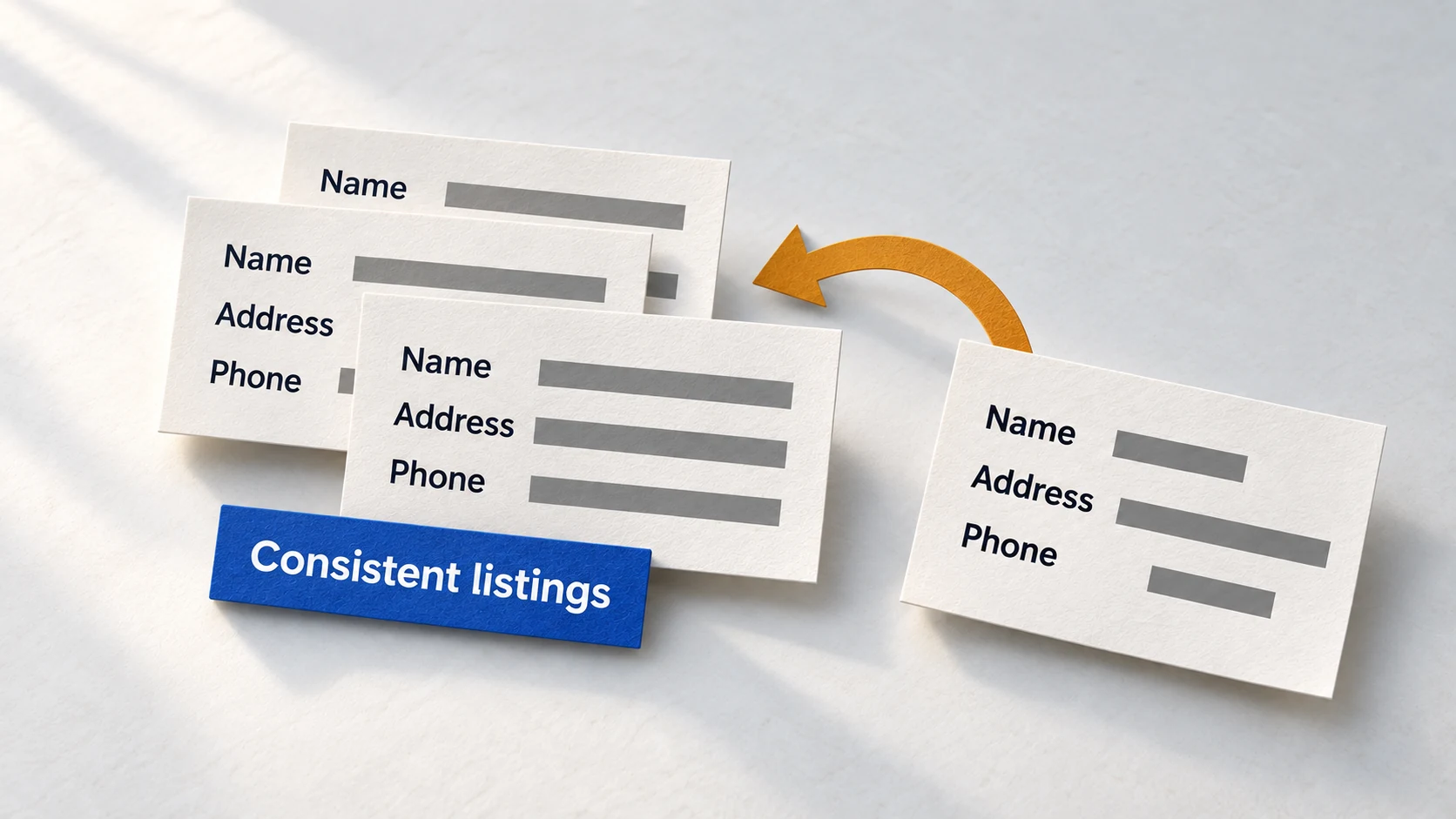
Local citations with consistent NAP (Name, Address, Phone) are the foundation of AI search visibility because AI engines cross-reference business data across multiple sources before making recommendations. Research shows inconsistent NAP data reduces AI citation probability by 67%, while businesses with consistent omnichannel data see 3.2x higher AI platform visibility. Priority platforms include Google Business Profile, Foursquare (powers 60-70% of ChatGPT local data), Yelp (appears in one-third of all local searches), and industry-specific directories. The strategy is quality over quantity: 20 perfectly consistent citations outperform 100 inconsistent ones. Audit quarterly, fix all variations immediately, and monitor for NAP drift.
Your website says "Founded 2015." Your LinkedIn says "2014." Your Yelp profile shows a different phone number than Google Business Profile. Your address has "Street" on some platforms and "St." on others.
These seem like minor details. They're not. AI engines verify your business by cross-referencing data across dozens of sources. When they find conflicts-even seemingly trivial ones-they reduce trust. And reduced trust means reduced recommendations.
This guide covers the complete citation strategy for AI visibility: which platforms actually matter, how to audit and fix inconsistencies, and how to maintain NAP consistency over time. Because in AI search, consistency isn't a detail-it's the foundation.
67%
reduction in AI citation probability from inconsistent NAP
A single address variation can dramatically impact whether AI recommends your business.
Source: Birdeye →3.2x
higher AI visibility with consistent omnichannel data
Businesses with verified, consistent information across platforms dramatically outperform fragmented competitors.
Source: Conductor →60-70%
of ChatGPT local data comes from Foursquare
If you're not on Foursquare-or your data there is wrong-ChatGPT may never find you.
Source: BrightLocal →NAP Consistency: How AI Engines Verify Your Business
AI engines don't take your word for it. Before recommending a business, they verify your existence and legitimacy by cross-referencing data from multiple sources. NAP consistency is how you pass that verification.
Definition
NAP Consistency
The practice of maintaining identical Name, Address, and Phone number information across all online platforms where your business appears. For AI search, this extends to NAP+W (adding Website) and should include business hours, categories, and key attributes. Consistency creates a verification signal that tells AI engines your business is real, active, and trustworthy.
Here's what happens every time someone asks AI for a local business recommendation. The AI runs through this verification sequence-and if your data fails at any step, you don't get recommended:
How AI Verification Works
- 1
Data Collection
AI scrapes business info from directories, social media, review sites, and your website. Each becomes a data point.
- 2
Cross-Reference
AI compares data across sources. Matching builds confidence. Conflicts trigger uncertainty.
- 3
Trust Scoring
Consistent data = higher trust score = confident recommendations. Low scores mean hedging or skipping.
- 4
Recommend or Skip
AI recommends trusted businesses. Can't verify basic facts? It chooses competitors with cleaner data.
Citation Impact on AI Trust
The gap between these two outcomes often comes down to small details-"Street" vs "St." or a missing suite number. What seems trivial to us creates real verification problems for AI.
The Compounding Effect
NAP consistency doesn't just affect one AI platform-it affects all of them. Google AI, ChatGPT, Perplexity, and voice assistants all perform similar verification processes. Fix your NAP once, and you improve visibility across every AI engine simultaneously.
The Local Citation Landscape: What AI Actually Accesses
Not all citations are equal. AI platforms source data from specific directories-understanding which ones matter most helps you prioritize where to build and maintain citations.
33%
of all local searches feature Yelp
Yelp appears in approximately one-third of local search results, often multiple times per query.
Source: BrightLocal →58%
of ChatGPT local results cite business websites
Your own website is a critical citation source-AI references it alongside directories.
Source: BrightLocal →This matrix shows which data sources each AI platform actually pulls from. Here's how to read it: "Primary" means that's the main source for that platform. "Yes" or "Some" means it's used but not the primary source. A dash (-) means that platform doesn't use that source at all. Focus your efforts on sources that appear across multiple columns-those give you the broadest coverage:
AI Platform Data Sources Matrix
| Data Source | ChatGPT | Google AI | Perplexity | Voice Assistants |
|---|---|---|---|---|
| Foursquare | Primary (60-70%) | - | Some | - |
| Yelp | Yes | Yes | - | Cross-platform |
| Business Website | 58% of results | Primary | Yes | - |
| TripAdvisor | Hospitality | - | Key source | - |
| Apple Maps | - | - | - | Siri Primary |
| Bing Places | - | - | - | Alexa Primary |
| MapQuest | - | - | Frequent | - |
| GBP | Secondary | Primary | - | Google Asst. |
Priority Platforms: Where to Build Citations First
With hundreds of potential directories, prioritization is essential. Focus first on platforms AI actually accesses, then expand to industry-specific sources.
Work from top to bottom-complete all Tier 1 platforms before moving to Tier 2. The funnel shape shows priority: wider at top means most important. The number tells you how many platforms are in each tier. Don't get overwhelmed by trying to do everything at once:
Citation Priority Tiers
6 Platforms
Tier 1 - Critical
GBP, Foursquare, Yelp, Apple Maps, Bing Places, Your Website
6 Platforms
Tier 2 - High Impact
Facebook, TripAdvisor, MapQuest, Yellow Pages, BBB, LinkedIn
6 Platforms
Tier 3 - Supporting
Data Axle, Localeze, Factual, Superpages, Citysearch, Chamber
Varies
Tier 4 - Industry
Healthgrades, Avvo, Angi, etc. - See industry section below
Warning
Most businesses skip Foursquare because they think it's just a check-in app. It's not-it's the primary data source for ChatGPT local recommendations. If your Foursquare listing doesn't exist or has wrong information, you're invisible to ChatGPT for local queries.
The NAP Audit Process: Finding and Fixing Inconsistencies
Before building new citations, audit existing ones. A single inconsistency can undermine everything else. Here's the systematic process for finding and fixing NAP problems.
This audit typically takes 2-4 hours spread across a few days. Steps 1-3 are hands-on work you can do yourself (about an hour). Step 4 requires a tool subscription if you want comprehensive coverage. Steps 5-6 happen over 2-4 weeks as your changes propagate through the system:
NAP Audit Process
Step 1
Document Your Standard NAP
Write down your exact, official NAP format. Business name (legal, no keywords), full address (consistent abbreviations), phone (pick one format). This becomes your template for everything.
Step 2
Search for Existing Citations
Google your business name + city. Check page 1-3 results. Note every listing you find. Search name variations (with/without LLC, abbreviations). Check data aggregator sites directly.
Step 3
Manual Priority Platform Check
Log into each Tier 1 platform: GBP, Foursquare, Yelp, Apple Maps, Bing Places. Compare NAP against your standard template. Note all discrepancies.
Step 4
Tool-Assisted Comprehensive Scan
Use BrightLocal, Moz Local, or Yext to scan 100+ directories automatically. Export inconsistency report. Prioritize fixes by platform importance.
Step 5
Fix All Inconsistencies
Update each platform to match your standard NAP exactly. Claim unclaimed listings first. Allow 2-4 weeks for changes to propagate through data aggregators.
Step 6
Verify and Monitor
Re-check Tier 1 platforms after 2 weeks. Set up quarterly audit reminders. Monitor for new user-generated listings that may introduce errors.
Create your own version of this template before you start auditing. The "note" column is where you document your formatting decisions-these become your rules for every platform. Once you've made these decisions, stick to them everywhere:
NAP Template Example
💡 Always include 'LLC' - it's our legal name
💡 Always 'Street' not 'St.' - Always 'Suite' not 'Ste'
💡 Always with parentheses around area code
💡 Always with https://, no trailing slash
✨ Save this template for consistent formatting across all platforms
Common NAP Variations That Confuse AI Engines
Small variations that seem trivial to humans create verification problems for AI. Here are the most common issues-and how to standardize them.
Business Name Variations
❌ Common Problems
- • "ABC Plumbing" vs "ABC Plumbing LLC"
- • "The Coffee Shop" vs "Coffee Shop"
- • "Dr. Smith's Dental" vs "Smith Dental Office"
- • Adding keywords: "ABC Plumbing - Best SF Plumber"
✓ Solution
- • Use exact legal business name everywhere
- • Include "LLC," "Inc.," "The" only if in legal name
- • Never add keywords or descriptors
- • Match signage, registration, tax documents
Address Variations
❌ Common Problems
- • "Street" vs "St." vs "St"
- • "Suite 100" vs "Ste 100" vs "#100" vs "Unit 100"
- • Including vs omitting zip+4
- • "North" vs "N." vs "N"
- • Missing apartment/suite numbers
✓ Solution
- • Pick one format and use everywhere
- • USPS standard is "St" but consistency matters more
- • Always include suite/unit if applicable
- • Don't mix abbreviation styles
- • Match Google Maps exactly
Phone Number Variations
❌ Common Problems
- • "(415) 555-1234" vs "415-555-1234"
- • "415.555.1234" vs "4155551234"
- • Different numbers on different platforms
- • Tracking numbers that change
- • Toll-free on some, local on others
✓ Solution
- • Pick one format (recommended: (xxx) xxx-xxxx)
- • Use local number (AI prefers local verification)
- • Same number everywhere-no tracking numbers
- • If toll-free needed, use one consistently
- • Must be answered by your business
Note
About 73% of customers lose faith in businesses with inconsistent information online. Beyond AI visibility, NAP consistency directly affects customer trust. When humans see different addresses or phone numbers, they wonder which is correct-and often choose a competitor instead.
Citation Building Strategy: Quality Over Quantity
The old citation game was about volume-get listed everywhere. The AI era demands quality. Twenty perfectly consistent citations outperform a hundred inconsistent ones.
These five principles guide every citation you build or update. They're not sequential steps-apply all five to each platform. Think of them as a quality checklist rather than a process:
Citation Building Principles
- 1
Prioritize AI Sources
Build Tier 1 first. Flawless Foursquare beats 50 low-quality directories.
- 2
Claim Before Building
Search for existing listings first-claim to correct, not create duplicates.
- 3
Complete 100%
Fill every field: description, categories, photos, hours, services.
- 4
Match Your Template
Every citation matches your NAP template exactly. No shortcuts.
- 5
Add sameAs Schema
Connect your entity across platforms with sameAs property.
sameAs Schema for Citation Connection
Add this to your LocalBusiness schema to connect citations:
sameAs Schema Example
"sameAs": [
  "https://www.yelp.com/biz/your-business",
  "https://www.facebook.com/yourbusiness",
  "https://foursquare.com/v/your-business/id",
  "https://www.linkedin.com/company/yourbusiness",
  "https://www.tripadvisor.com/your-business",
  "https://www.bbb.org/your-business"
]
Citation Building & Management Tools
BrightLocal
Citation audit, building, and monitoring for 2-50 locations. Finds inconsistencies across 1,000+ sites. Starts at $39/month.
Learn more →Moz Local
Citation distribution with real-time sync. Pushes NAP data to major aggregators and directories. Starts at $149/year.
Learn more →Yext
Enterprise citation management with direct API integrations. Best for 50+ locations needing real-time updates. Enterprise pricing.
Learn more →Whitespark
Citation finder and building service. Manual, high-quality citation building with local expertise. Project-based pricing.
Learn more →Industry-Specific Directories for Maximum AI Impact
General directories establish baseline visibility. Industry-specific directories signal expertise and authority to AI engines looking for specialized recommendations.
Find your industry below and focus on those specific directories first. If your business spans multiple industries (say, a medical spa that's both healthcare and beauty), check each relevant section:
Find Your Industry Directories
Question
Which industry best describes your business?
Prioritize healthcare directories
Healthgrades, Zocdoc, Vitals, WebMD, RateMDs, Doximity. These are critical for 'doctor near me' queries.
Prioritize legal directories
Avvo, FindLaw, Justia, Martindale-Hubbell, Lawyers.com. Essential for 'attorney near me' queries.
Prioritize home services directories
Angi (Angie's List), HomeAdvisor, Houzz, Thumbtack, Porch. Critical for contractor and service queries.
Prioritize hospitality directories
OpenTable, Zomato, Grubhub, DoorDash, The Infatuation, Eater. Essential for dining recommendations.
Prioritize real estate directories
Zillow, Realtor.com, Trulia, Homes.com, Redfin. Critical for agent and property queries.
Prioritize financial directories
NerdWallet, Bankrate, WalletHub, SmartAsset. Important for advisor and service queries.
Prioritize auto directories
Cars.com, AutoTrader, CarGurus, RepairPal, Kelley Blue Book. Essential for dealer and service queries.
Focus on general + local directories
Prioritize Tier 1-3 general directories plus local Chamber of Commerce, city business directories, and any niche directories specific to your offering.
Why Industry Directories Matter for AI
When AI answers "best cardiologist in Chicago," it doesn't just check general directories-it looks for signals from sources that specialize in healthcare recommendations. Industry directories provide expertise verification that general directories can't match. Missing from Healthgrades when you're a doctor? AI has less confidence recommending you for medical queries.
Citation Monitoring: Preventing NAP Drift
NAP consistency isn't a one-time fix. Directories change, data aggregators update, and user-generated listings can introduce errors. Ongoing monitoring prevents "NAP drift" from undermining your AI visibility.
Set calendar reminders for each of these check-ins. The "Trigger" row (highlighted) is the most important one-any time your business information changes, you need to update all platforms within 48 hours or risk creating new inconsistencies:
Citation Monitoring Cadence
Alerts & Reviews
Check Google Alerts, respond to reviews, note new user-generated listings
Tier 1 Verification
Verify GBP, Foursquare, Yelp, Apple Maps, Bing. Check for duplicates.
Full NAP Audit
Run BrightLocal scan, check industry directories, review data aggregators
Info Changes
Any change → Update all within 48hrs. Phone change → Verify ALL platforms immediately.
- Weekly
Alerts & Reviews
Check Google Alerts, respond to reviews, note new user-generated listings
- Monthly
Tier 1 Verification
Verify GBP, Foursquare, Yelp, Apple Maps, Bing. Check for duplicates.
- Quarterly
Full NAP Audit
Run BrightLocal scan, check industry directories, review data aggregators
- Trigger
Info Changes
Any change → Update all within 48hrs. Phone change → Verify ALL platforms immediately.
Google Alerts (left column) help you catch the drift causes shown on the right. Set up the alerts first, and they'll automatically notify you when new listings appear or existing ones change:
Set Up Google Alerts
- 1
Go to Alerts
Visit google.com/alerts
- 2
Business Name
Create alert for exact name
- 3
Name + City
Add geographic variation
- 4
Misspellings
Cover common typos
- 5
Set Frequency
As-it-happens or daily
Common Drift Causes
Watch out for these-they can undo your careful work:
- 1. Aggregators - Data aggregators overwrite your corrections
- 2. User Edits - User-submitted corrections with wrong info
- 3. Auto-Scraping - Platform auto-updates from web scraping
- 4. Staff Errors - Staff updating one platform, not others
- 5. Old Materials - Outdated marketing materials circulating
Pro Tip
When you change any business information, update data aggregators FIRST (Data Axle, Localeze, Factual). These feed hundreds of downstream directories. If you only update individual directories, aggregators may overwrite your changes within weeks.
FAQ
What is NAP consistency and why does it matter for AI search?
How many citations does a local business need?
Which directories do AI engines actually use for local data?
How do I find NAP inconsistencies?
What counts as a NAP inconsistency?
How often should I audit my citations?
Ready to Build AI-Trusted Citations?
Consistent NAP across platforms creates the verification signal AI engines need to recommend your business confidently.
67% visibility reduction from inconsistent NAP-fix it first.
Take the GEO Readiness Quiz →60 seconds · Personalized report · Free
Continue Learning
Dive deeper into AI search with these related articles:
Local Business GEO: How Small Businesses Can Compete in AI Search
40.2% of local searches trigger AI Overviews. Learn the complete Local GEO framework: Google Business Profile optimization, LocalBusiness schema, NAP consistency, reviews, and hyperlocal content.
Google Business Profile Optimization for AI Search
Make your Google Business Profile the entity record AI engines verify and recommend. The complete GBP optimization checklist for AI search visibility.
Entity Optimization Masterclass: AI Brand Recognition
Master the complete framework for establishing your brand as a recognized entity in AI systems. From Entity Homes to Wikidata to knowledge panels.