EMA Regulatory
Borderline Products: The Advice Pathway Nobody Maps
Quick Answer
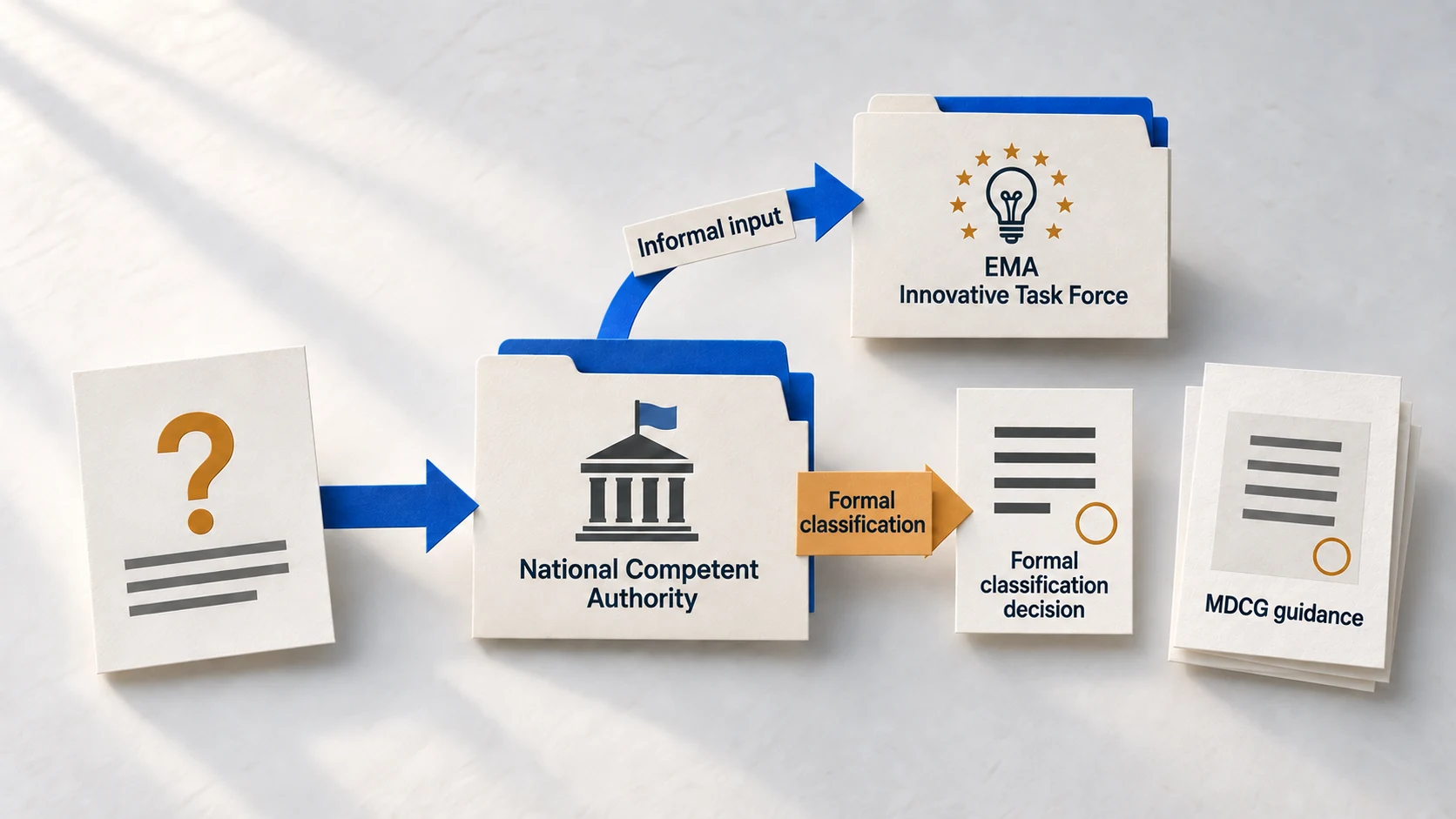
For borderline drug-device products, National Competent Authorities (NCAs) are your primary source of formal classification advice. EMA's Innovative Task Force provides informal scientific input for novel combinations but cannot substitute for NCA decisions. The MDCG Borderline Guidance and Manual offer interpretation frameworks, and Article 4(11) MDR provides an escalation mechanism when Member States disagree. Contact the relevant NCA early-ideally six months before submission.
Part 2 of a deep-dive series analyzing EMA's Questions and Answers on MDR/IVDR implementation. Part 1 covered Q1: DDC Classification. This post examines Q2-where to get advice when your product sits in the grey zone between drug and device.
The validation audit is tomorrow, and she's still not sure she's talking to the right authority.
Two months ago, her team submitted a classification request to the national medicines agency. Last week, an informal response suggested they should have contacted the devices authority instead-because the product's therapeutic coating might be ancillary rather than principal.
Now the submission timeline is slipping, the notified body engagement is on hold, and the question she started with is still unanswered: is this a medicinal product or a medical device?

The problem isn't a lack of available advice. There are at least three bodies she could have approached, each with a different mandate, different authority, and different implications for her submission. The problem is that nobody maps which one to approach first, which one gives binding answers, and which one is a courtesy that won't hold up when it matters.
EMA's Q&A Question 2 addresses exactly this-and what it reveals is a system that makes sense once you see it clearly, but creates costly confusion when you don't.
What Q2 Actually Addresses
Why this matters: Q2 answers the question regulatory teams ask most often in practice-not "how do I classify?" but "who do I ask when I can't classify on my own?" The answer involves multiple authorities, each with a distinct role that most teams conflate.
EMA's Q&A on MDR/IVDR implementation dedicates Q1.3 (commonly referred to as "Q2" in the advice context) to the specific question: "How to obtain advice on the qualification/classification of my drug-device combination, especially for borderline products?"
The answer the Q&A provides is layered, and that's where the confusion starts. It references multiple bodies-national competent authorities, the MDCG, EMA's Innovative Task Force-without stating explicitly which one to approach first or which one's answer carries the most weight.
But there is a hierarchy, and understanding it prevents the exact scenario that opens this post: months lost asking the wrong authority for the wrong type of advice.
The qualification and classification of borderline products-determining whether they should be regulated as a medicinal product or a medical device-is primarily the responsibility of the national competent authorities for medicinal products and/or medical devices.
That word-primarily-is doing significant work. It establishes the NCA as the authority whose classification decision actually matters for your regulatory pathway. Everything else is supplementary.
The Three Sources of Borderline Advice
Why this matters: Each advisory body serves a different purpose, operates at a different level of formality, and produces outcomes with different regulatory weight. Treating them as interchangeable is the most common and most expensive mistake teams make.
Advisory Bodies for Borderline Classification
| Aspect | National Competent Authority (NCA) | EMA Innovative Task Force (ITF) | MDCG Guidance & Manual |
|---|---|---|---|
| Type of Advice | Formal classification decision | Informal scientific input | Interpretive framework and precedent |
| Regulatory Weight | Binding in that Member State | Non-binding, informational only | Guidance-not legally binding but widely referenced |
| Who Initiates | Manufacturer requests | Manufacturer requests ITF meeting | Publicly available-no request needed |
| Best For | Definitive classification before submission | Early-stage novel combinations | Understanding existing borderline interpretations |
| Timeline | 2–6 months (varies by Member State) | Weeks to schedule, faster turnaround | Immediate (published documents) |
| Cost | Varies by NCA (some free, some charge fees) | EMA fees apply (SME reductions available) | Free (public documents) |
The critical distinction: Only the NCA provides a classification decision you can actually build a submission strategy around. The ITF gives you scientific perspectives that help you refine your thinking-but if an NCA later disagrees, the ITF input won't protect you. And the MDCG guidance tells you how similar products have been interpreted-but your specific product still needs a case-by-case NCA decision.
1. National Competent Authorities: The Formal Route
NCAs for medicinal products and NCAs for medical devices jointly hold the authority to formally classify borderline products. This is where Q2 directs manufacturers first, and with good reason-the NCA classification is what your notified body, your marketing authorization assessment, and your entire submission strategy will ultimately depend on.
Each EU Member State has its own NCA structure. Some have a single authority covering both medicinal products and devices. Others have separate authorities-one for pharmaceuticals, another for medical devices-and for borderline products, you may need to engage both.
2. EMA's Innovative Task Force: The Informal Route
For innovative drug-device combinations where classification is genuinely novel-products that don't have clear precedent in the existing MDCG manual or NCA decisions-the EMA's Innovative Task Force offers a different kind of support. The ITF provides informal scientific input on borderline therapeutics, helping manufacturers understand the regulatory landscape before they commit to a formal classification pathway.
The key word is informal. An ITF meeting can sharpen your thinking, expose blind spots in your classification rationale, and signal how regulators are likely to view your product. But it does not produce a classification decision, and it does not substitute for NCA advice.
3. MDCG Borderline Guidance: The Reference Framework
The Medical Device Coordination Group publishes two documents that form the interpretive backbone for borderline classification: MDCG 2022-5 (Guidance on borderline between medical devices and medicinal products under MDR) and the MDCG Manual on borderline and classification, which records the views of Member State representatives on specific product types.
These documents are where you start your analysis-before contacting any authority. If a product similar to yours has already been addressed in the MDCG manual, that precedent significantly strengthens your position when approaching the NCA. If your product is genuinely novel and the manual doesn't address it, that's useful information too-it tells you that you're likely in ITF territory.
Who to Approach Based on Your Situation
Why this matters: The right starting point depends on where your product falls on the novelty spectrum. A product with clear MDCG precedent needs a different approach than one that's genuinely first-of-its-kind.
Where to Start with Borderline Advice
Question
How novel is your borderline product?
Start with NCA - reference MDCG precedent in your request
The MDCG manual's existing interpretation strengthens your case. Approach the NCA with your classification rationale supported by the relevant MDCG entry.
Start with NCA - include detailed PMOA analysis
Your product may be borderline, but the classification framework from Q1 can be applied. Prepare thorough mechanism-of-action documentation for the NCA.
Consider EMA ITF first, then follow up with NCA
The ITF's informal input can help you frame your classification before committing to a formal NCA request. Use ITF insights to strengthen your NCA submission.
Start with NCA - reference MDCG precedent in your request
The MDCG manual's existing interpretation strengthens your case. Approach the NCA with your classification rationale supported by the relevant MDCG entry.
Start with NCA - include detailed PMOA analysis
Your product may be borderline, but the classification framework from Q1 can be applied. Prepare thorough mechanism-of-action documentation for the NCA.
Consider EMA ITF first, then follow up with NCA
The ITF's informal input can help you frame your classification before committing to a formal NCA request. Use ITF insights to strengthen your NCA submission.
Important nuance: Even when the ITF route makes sense as a first step, the NCA remains the destination. The ITF sharpens your rationale-the NCA makes the decision. Teams that treat ITF input as their classification answer often discover this distinction painfully when the NCA in their chosen Member State takes a different view.
The Step-by-Step Advice Pathway
Why this matters: The advice pathway has a logical sequence, but Q2 doesn't present it as a numbered process. Mapping it out prevents backtracking and wasted months.
Borderline Product Advice Pathway
- 1
Review MDCG Guidance Documents
Check MDCG 2022-5 and the Borderline Manual for existing interpretations. If your product type has precedent, note the relevant entries and the classification reasoning used.
- 2
Build Your Classification Rationale
Document principal mode of action, mechanism analysis, and supporting clinical data. Reference MDCG precedent where applicable. This becomes the basis for any formal request.
- 3
Decide: NCA Direct or ITF First
If precedent exists, go directly to NCA. If your product is genuinely novel with no precedent, consider an ITF meeting first to test your rationale before committing to a formal path.
- 4
Contact the Appropriate NCA
Identify the NCA for both medicinal products and medical devices in your target Member State. Submit your classification request with full rationale and supporting documentation.
- 5
Receive and Document NCA Decision
The NCA's formal classification determines your regulatory pathway. Document the decision and integrate it into your submission strategy-this is the basis for notified body engagement and marketing authorization planning.
The Article 4(11) Escalation
There's a fourth mechanism that Q2 touches on indirectly: MDR Article 4(11), which allows the European Commission-on its own initiative or at a Member State's request-to determine whether a specific product falls within the definition of a medical device.
This is the escalation pathway. It exists for situations where Member States disagree on classification, or where a product creates a precedent-setting question that affects the single market. Manufacturers don't invoke Article 4(11) directly-it's a regulatory mechanism between Member States and the Commission. But knowing it exists explains why NCA decisions, while binding in their Member State, may not settle the question for cross-border products if different NCAs reach different conclusions.
What to Prepare Before Seeking Advice
Why this matters: The quality of the advice you receive is directly proportional to the quality of the question you ask. NCAs and the ITF are far more helpful when you present a well-structured classification rationale rather than an open-ended "what is my product?"
Borderline Classification Request Preparation
- Detailed product description including all components and their functions
- Mechanism of action analysis-how the product achieves its principal therapeutic effect
- PMOA determination with supporting scientific evidence
- Reference to comparable products in the MDCG Manual (if any exist)
- Clinical data or literature supporting your claimed mechanism
- Your proposed classification rationale (drug-led or device-led)
- Identification of the specific borderline question you need resolved
- Intended use statement and patient population
- Summary of any previous regulatory interactions on this product
Pro tip: Frame your request as "we believe this is classified as X because of Y-do you concur?" rather than "please classify our product." The former demonstrates regulatory maturity and gives the authority a concrete rationale to evaluate. The latter forces them to build the analysis from scratch, which delays the response and may produce a less favourable outcome because you've lost the opportunity to frame the argument.
Where Manufacturers Go Wrong
Why this matters: These mistakes don't just waste time-they create classification ambiguity that follows your product through the entire regulatory lifecycle.
Treating ITF Input as a Classification Decision
The ITF provides informal scientific views. Teams that build their entire submission strategy on ITF input without following up with NCA formal advice are vulnerable to reclassification late in the process-when the cost of changing course is highest.
Asking the Wrong NCA First
Some Member States have separate authorities for medicines and devices. If your product is borderline, contacting only the medicines authority (or only the devices authority) may result in being redirected-adding months to your timeline. Identify both NCAs and determine whether a joint consultation is possible.
Ignoring MDCG Precedent
The MDCG Manual records borderline classification views from Member State experts. Approaching an NCA without referencing relevant MDCG entries-or worse, contradicting them without acknowledging the discrepancy-undermines your credibility and invites additional scrutiny.
Waiting Too Long to Seek Advice
EMA recommends seeking classification advice at least six months before planned submission. Teams that delay until the product is development-complete and submission-ready have no room to adjust if the NCA classifies differently than expected.
FAQ
Who decides whether a borderline product is a drug or a medical device in the EU?
What is the EMA Innovative Task Force (ITF) and when should I use it?
What is Article 4(11) of the MDR and how does it relate to borderline products?
How long does it take to get borderline product advice from an NCA?
Is there a fee for obtaining borderline product classification advice?
Still Uncertain About Your Product's Classification?
Borderline products don't sort themselves. Two minutes to see whether your classification rationale would hold up under formal assessment.
Stop searching through hundreds of PDFs. Get authoritative answers in seconds.
Check Your Approach →5 questions · Personalized insights · Free