EMA Regulatory
UDI Requirements Under EU MDR: Complete Implementation Guide
Quick Answer
The MDR Unique Device Identification (UDI) system requires three identifier levels: Basic UDI-DI (for EUDAMED grouping), UDI-DI (specific device model), and UDI-PI (production information). All devices must carry UDI carriers (barcode + human-readable) on labels and be registered in EUDAMED before market placement.
You're updating your labeling for MDR compliance. Someone asks: "Do we need a Basic UDI-DI, a UDI-DI, or both? And what goes in EUDAMED?"
You pause. The UDI system has three different identifiers, each with different purposes. Get it wrong, and your device can't legally enter the EU market.
This guide breaks down the complete UDI system, from structure to implementation.
What Is the Unique Device Identification System?
The Unique Device Identification (UDI) system is a global initiative to identify medical devices throughout their distribution and use. Under MDR Article 27, manufacturers must assign UDIs to their devices and register them in EUDAMED.
The UDI system serves multiple purposes:
"The UDI system should enhance the effectiveness of post-market safety-related activities for devices by improving incident reporting, targeted field safety corrective actions and monitoring by competent authorities."
Key Benefits of UDI
For Regulators
- • Enhanced market surveillance
- • Faster incident investigation
- • Improved recall effectiveness
- • Better device traceability
For Healthcare Systems
- • Supply chain transparency
- • Patient safety tracking
- • Counterfeit detection
- • Inventory management
UDI Structure: Basic UDI-DI, UDI-DI, and UDI-PI
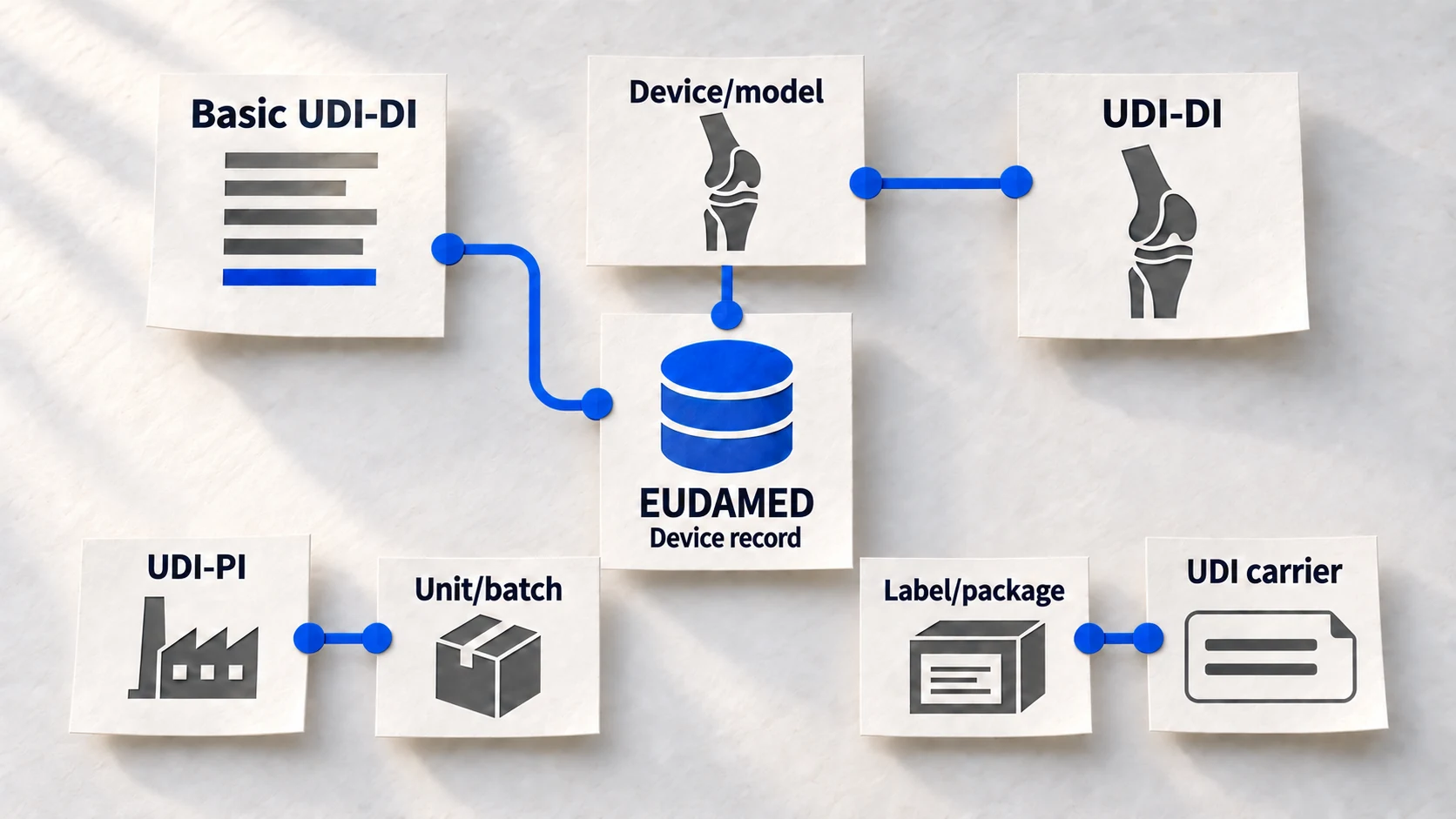
The MDR UDI system consists of three distinct identifier levels. Understanding when each applies is essential for compliance.
Basic UDI-DI
The primary identifier for regulatory database registration
The Basic UDI-DI is the main key for device records in EUDAMED. It groups together all UDI-DIs that share the same intended purpose, risk class, and essential design characteristics.
Used for: EUDAMED registration, certificates, EU Declaration of Conformity
UDI-DI (Device Identifier)
Identifies the specific device model
The UDI-DI is a fixed, static identifier for a specific device version or model. It changes when there's a modification that could affect safety, performance, or intended use.
Used for: Device labels, packaging, product identification
UDI-PI (Production Identifier)
Variable production information
The UDI-PI contains variable production data that identifies individual units or batches: lot/batch number, serial number, manufacturing date, and/or expiration date.
Used for: Traceability, recall management, expiration tracking
How the Three Levels Relate
| Identifier | Scope | On Label? | In EUDAMED? |
|---|---|---|---|
| Basic UDI-DI | Device family/group | No | Yes (primary key) |
| UDI-DI | Specific model | Yes | Yes (linked to Basic) |
| UDI-PI | Unit/batch level | Yes (if applicable) | No |
UDI Carrier: AIDC and HRI Requirements
The UDI carrier is the physical representation of the UDI on the device label or packaging. MDR requires both machine-readable and human-readable formats.
AIDC (Automatic Identification and Data Capture)
Machine-readable format
- • Linear barcodes (Code 128)
- • 2D barcodes (Data Matrix, QR)
- • RFID (where appropriate)
Must encode complete UDI (UDI-DI + UDI-PI)
HRI (Human Readable Interpretation)
Plain text format
- • Legible text characters
- • All UDI elements displayed
- • Readable without equipment
Must appear alongside AIDC
Important
Both AIDC and HRI must be present on the label or packaging. If space constraints prevent both on the device itself, the HRI must at minimum appear on the device, with the AIDC on the packaging.
EUDAMED Registration Requirements
EUDAMED is the European database for medical devices. Manufacturers must submit UDI data to EUDAMED before placing devices on the market.
What Must Be Registered
- • Basic UDI-DI data: Manufacturer details, device classification, intended purpose, risk class
- • UDI-DI data: Specific device attributes, variants, packaging configurations
- • Certificate information: Links to Notified Body certificates
- • Market status: Countries where device is placed on market
- • Authorized representative: For non-EU manufacturers
Updates must be submitted within specified timeframes when device information changes, when certificates are issued/modified, or when market status changes.
Implementation Timelines by Device Class
MDR established staggered timelines for UDI implementation based on device risk class.
| Device Class | UDI on Label | EUDAMED Registration |
|---|---|---|
| Class III & Implantables | 26 May 2021 | 26 May 2021 |
| Class IIa & IIb | 26 May 2023 | 26 May 2023 |
| Class I | 26 May 2025 | 26 May 2025 |
| Reusable (direct marking) | 26 May 2023 (Class III) | - |
Current Status (2026)
As of 2026, all device classes must comply with UDI labeling and EUDAMED registration requirements. Devices placed on the market under transition provisions must be updated to include UDI when certificates are renewed or as specified in MDR Article 123.
Labeling Requirements and Placement
UDI carrier placement varies depending on packaging levels and whether the device is reusable.
Packaging Level Requirements
Device Level
UDI carrier on the device label or, for small devices, the Instructions for Use.
Unit-of-Use Package
Each individual package must carry a UDI carrier with UDI-DI and applicable UDI-PI elements.
Higher-Level Packaging
Shipping containers and intermediate packaging require UDI carriers if UDI-PI differs from inner packages.
Direct Marking for Reusable Devices
Reusable devices intended for reprocessing must have UDI directly marked on the device itself. Requirements include:
- • Must remain legible through expected device lifecycle
- • Withstand reprocessing cycles (cleaning, disinfection, sterilization)
- • Direct marking methods include laser etching, dot peen, electrochemical etching
- • Validation required to confirm marking durability and device safety is unaffected
Issuing Entities: GS1, HIBCC, ICCBBA, IFA
The European Commission has designated four issuing entities for UDI assignment:
| Entity | Primary Use | Key Characteristics |
|---|---|---|
| GS1 | Most device types | Most widely used globally; integrates with retail supply chains |
| HIBCC | Healthcare products | Healthcare-specific; common in US hospital systems |
| ICCBBA | Blood, tissue, cells | ISBT 128 standard; required for substances of human origin |
| IFA | German market | PPN codes; common in German pharmaceutical supply chains |
Choose your issuing entity based on your existing systems, supply chain requirements, and primary market focus. You may use different entities for different product lines, but consistency within product families simplifies management.
Practical Steps for UDI Compliance
Implementing UDI requires coordination across regulatory affairs, labeling, quality, and IT. Here's a practical approach:
Select Your Issuing Entity
Evaluate GS1, HIBCC, ICCBBA, and IFA based on your product portfolio, existing systems, and market requirements. Obtain the necessary company prefix or accreditation.
Define Your UDI Architecture
Determine how to group devices under Basic UDI-DIs. Map your product families, variants, and configurations to establish the UDI-DI structure.
Update Labeling Systems
Modify label templates to include AIDC carriers (barcodes) and HRI text. Validate barcode quality per ISO/IEC 15415 and ISO/IEC 15416.
Register in EUDAMED
Create your EUDAMED Actor Registration, then submit Basic UDI-DI and UDI-DI data. Establish processes for ongoing data maintenance.
Validate and Document
Verify barcode scannability, HRI legibility, and direct marking durability. Document your UDI assignment procedures in your QMS.
Key Success Factor
Build UDI management into your change control process. Any change affecting a device's identity, safety, performance, or intended use may require a new UDI-DI-catch these changes early in your design control process.
FAQ
What's the difference between Basic UDI-DI, UDI-DI, and UDI-PI?
When is EUDAMED registration required for UDI?
Which issuing entity should I use for UDI?
Do reusable devices need UDI marking on the device itself?
Need Instant Clarity on UDI Compliance?
You've seen how detailed UDI requirements can be. Our platform delivers instant, authoritative answers on UDI structure, EUDAMED registration, and labeling.
Stop searching through hundreds of PDFs. Get authoritative answers in seconds.
Get Regulatory Guidance → →5 questions · Personalized insights · Free