EMA Regulatory
Medicinal Product vs Medical Device: The Borderline Determination Guide
Quick Answer
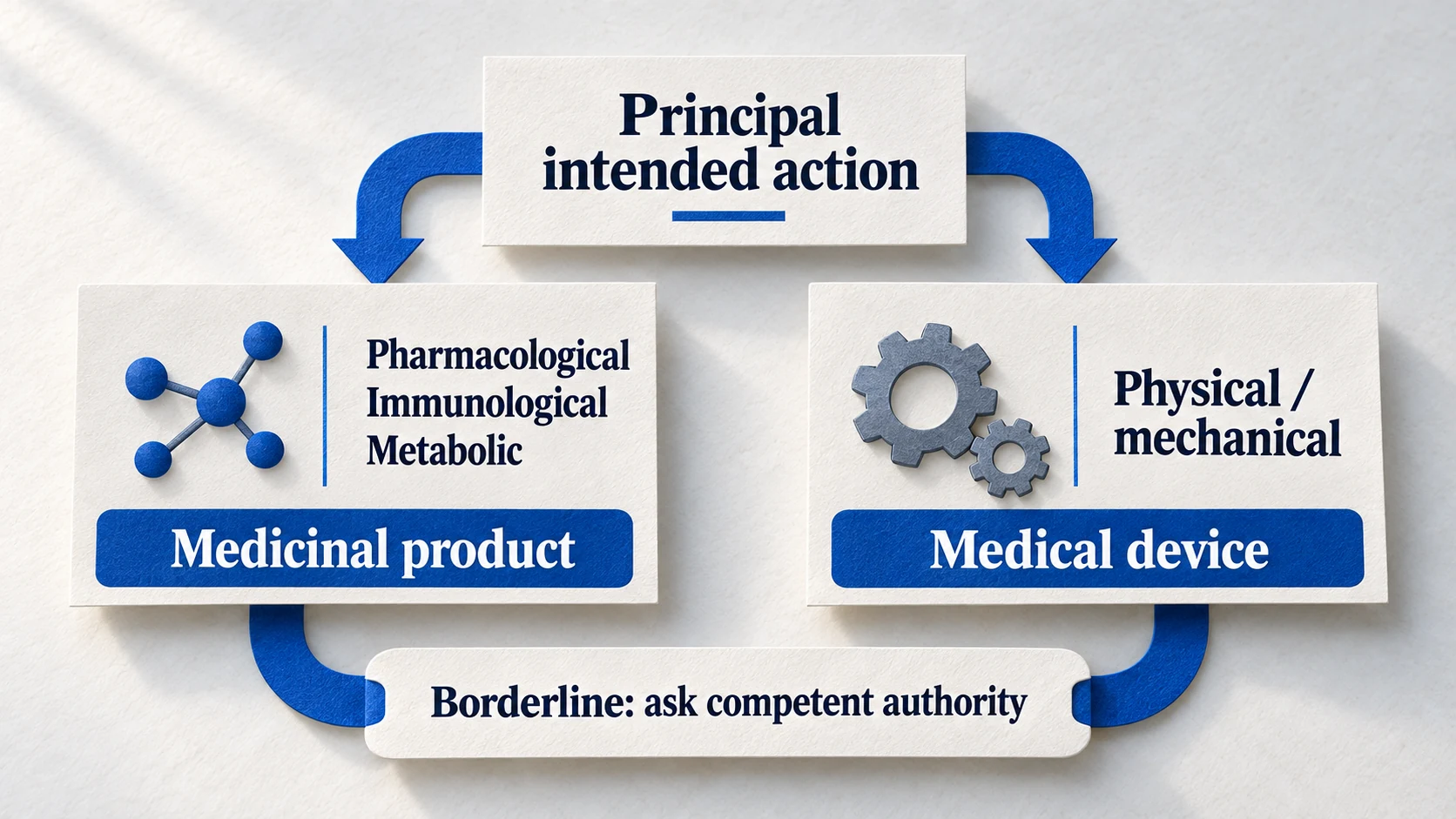
A product is a medicinal product if its principal intended action is achieved through pharmacological, immunological, or metabolic means. A product is a medical device if its principal intended action is achieved through physical or mechanical means-even if assisted by pharmacological means. The qualification is made by national competent authorities, with guidance available from MDCG 2022-5 and the EMA's Innovative Task Force for complex borderline cases.
She overheard the conversation at a regulatory conference coffee break. Two directors from competing companies, discussing the same product category.
One had filed under pharmaceutical legislation. The other was pursuing CE marking.
Same mechanism of action. Same intended use. Different regulatory conclusions.

Both companies had defensible positions. Both had documented their reasoning. Neither was definitively wrong-but they would face very different regulatory pathways, timelines, and approval bodies.
The borderline between medicinal products and medical devices isn't a bright line. It's a determination based on principal intended action-and for products near the boundary, that determination requires careful analysis and often formal authority guidance.
The Fundamental Definitions
Why this matters: These definitions have legal force and are the starting point for any classification analysis. Understanding the exact regulatory language prevents misinterpretation.
Medicinal Product Definition
Directive 2001/83/EC Article 1(2) defines a medicinal product as:
"(a) Any substance or combination of substances presented as having properties for treating or preventing disease in human beings; or
(b) Any substance or combination of substances which may be used in or administered to human beings either with a view to restoring, correcting or modifying physiological functions by exerting a pharmacological, immunological or metabolic action, or to making a medical diagnosis."
Medical Device Definition
MDR 2017/745 Article 2(1) defines a medical device as:
"Any instrument, apparatus, appliance, software, implant, reagent, material or other article intended by the manufacturer to be used, alone or in combination, for human beings for one or more of the following specific medical purposes:
- diagnosis, prevention, monitoring, prediction, prognosis, treatment or alleviation of disease,
- diagnosis, monitoring, treatment, alleviation of, or compensation for, an injury or disability,
- investigation, replacement or modification of the anatomy or of a physiological or pathological process or state..."
The critical distinction in the device definition: the product "does not achieve its principal intended action in or on the human body by pharmacological, immunological or metabolic means, but which may be assisted in its function by such means."
The Key Criterion: Principal Intended Action
Why this matters: This single criterion drives the entire classification. If you can definitively establish the principal intended action, you've answered the fundamental regulatory question.
Question
What is the Principal Intended Action?
MEDICINAL PRODUCT under Directive 2001/83/EC or Regulation 726/2004
MEDICAL DEVICE under MDR 2017/745
MEDICINAL PRODUCT under Directive 2001/83/EC or Regulation 726/2004
MEDICAL DEVICE under MDR 2017/745
Let's define each mode of action:
Modes of Action Definitions
| Mode of Action | Definition | Examples |
|---|---|---|
| Pharmacological | Interaction between substance and cellular components (receptors, enzymes, transporters) | Drug-receptor binding, enzyme inhibition, ion channel blocking |
| Immunological | Action mediated by/on the immune system | Vaccines, immunomodulators, allergen immunotherapy |
| Metabolic | Involvement in or modification of chemical reactions in the body | Nutrients, hormones, enzymatic catalysis |
| Physical/Mechanical | Action achieved through physical means without pharmacological mechanism | Barriers, scaffolds, mechanical support, fluid dynamics |
The "Assisted By" Clause
A product can be a medical device even if it's assisted by pharmacological, immunological, or metabolic means-as long as those means are not the principal action. For example, a wound dressing with antimicrobial coating (physical barrier is principal; antimicrobial is assistive) may be a device. A wound gel that heals through growth factor release (pharmacological is principal) would be a medicinal product.
Borderline Product Assessment Process
Why this matters: Borderline products are those where classification isn't immediately clear. Having a structured assessment approach-and knowing when to seek authority guidance-prevents costly classification errors.
The qualification and classification of borderline products is the responsibility of national competent authorities for medicinal products and/or medical devices. This isn't a decision manufacturers make unilaterally-though they must justify their position.
Borderline Assessment Process
- 1
Analyze Mechanism of Action
Document how the product achieves its therapeutic effect-pharmacological, immunological, metabolic, or physical?
- 2
Determine Principal vs Ancillary
If multiple mechanisms exist, which is principal and which is supportive?
- 3
Review Precedents
Check MDCG guidance and similar products' classifications for reference
- 4
Seek Authority Guidance
For genuinely borderline cases, request formal NCA classification advice
- 5
Document Rationale
Record the classification decision with scientific justification
Key guidance documents for borderline assessment:
- MDCG 2022-5: Guidance on borderline between medical devices and medicinal products under MDR
- MDCG Manual on borderline and classification: Explanations and worked examples
- EMA Q&A on MDR/IVDR implementation: Addresses combination products specifically
EMA and Competent Authority Advice Procedures
Why this matters: Knowing where to get authoritative guidance-and the difference between informal input and formal decisions-helps you navigate borderline classifications efficiently.
Informal Input: EMA Innovative Task Force (ITF)
EMA's Innovative Task Force provides early, informal scientific input for innovative drug-device combinations and borderline products. Key characteristics:
What ITF Provides
- • Early dialogue on development approach
- • Scientific input on borderline classification
- • Guidance on regulatory pathway considerations
- • Non-binding, informal perspective
What ITF Does NOT Provide
- • Formal classification decisions (NCA responsibility)
- • Binding regulatory advice
- • Replacement for NCA consultation
- • Guarantee of regulatory acceptance
Formal Advice: National Competent Authorities
For formal classification decisions, contact a national competent authority. The recommendation is to seek this advice before submitting an application-not during assessment when timeline pressure is highest.
Before Seeking NCA Advice
- Document your preliminary classification rationale
- Compile scientific evidence for mechanism of action
- Identify comparable products and their classifications
- Prepare specific questions for the authority
- Include relevant MDCG guidance references
- Consider both pharmaceutical and device NCA perspectives
European Commission Decisions
The European Commission can issue decisions, at the request of a Member State, on whether a product or product group falls within the definition of a medical device. These decisions provide legal certainty across all Member States but are relatively rare and reserved for products of broader significance.
Borderline Product Examples
Why this matters: Abstract criteria become clearer through concrete examples. These products illustrate how the principal intended action test applies-and where borderline cases arise.
Clearly Medicinal Products
- • Vaccines - Immunological action is principal
- • Hormone replacement therapy - Metabolic action is principal
- • Enzyme replacement products - Metabolic action is principal
- • Oral contraceptives - Pharmacological action is principal
- • Insulin products - Metabolic action is principal
- • Monoclonal antibodies - Pharmacological/immunological action is principal
Clearly Medical Devices
- • Hip implants - Mechanical support is principal
- • Pacemakers - Electrical stimulation is principal
- • Surgical instruments - Physical cutting/manipulation is principal
- • Contact lenses - Optical correction is principal
- • Condoms - Physical barrier is principal
- • Blood pressure monitors - Physical measurement is principal
Borderline Products (Require Case-by-Case Analysis)
Wound Care Products:
- • Simple dressing (physical barrier) → Device
- • Dressing with antimicrobial (barrier principal, antimicrobial assistive) → Usually device
- • Wound gel with growth factors (pharmacological is principal) → Medicinal product
Oral Products:
- • Antacid tablets (chemical neutralization) → Often medicinal product
- • Barrier-forming reflux products (physical barrier principal) → May be device
- • Probiotic products → Depends on claimed mechanism and intended use
Dermatological Products:
- • Moisturizers (physical hydration barrier) → Usually cosmetic or device
- • Products claiming to modify skin structure → May be medicinal product
- • Scar treatment products → Depends on claimed mechanism
When Classification Is Disputed
Why this matters: Disputes happen. Knowing the resolution mechanisms-and how to avoid disputes in the first place-protects your regulatory timeline.
The regulations are clear: the procedures of the medical device directives and the medicinal products directive do not apply cumulatively. One framework governs-based on principal mode of action. But what happens when stakeholders disagree?
Manufacturer vs Notified Body Disputes
If a manufacturer and Notified Body disagree on device classification, the dispute is referred to the national competent authority for medical devices in the Member State where the manufacturer is registered. The NCA decision is binding for that conformity assessment.
Cross-Border Considerations
Different Member States may reach different conclusions on borderline products. While MDCG guidance promotes harmonization, NCA decisions remain national. If market access across multiple Member States is planned, consider:
- Seeking guidance from multiple NCAs early
- Using established classifications of similar products as precedent
- Requesting European Commission decision for products of broader significance
Prevention Is Better Than Resolution
Classification disputes cause delays measured in months. The most effective approach is seeking NCA guidance before submission-not defending a position after the fact. Document your rationale thoroughly, reference comparable products, and engage authorities early for genuinely borderline cases.
A Practical Determination Framework
Step 1: Analyze the Mechanism of Action
- Ask: How does the product achieve its therapeutic/diagnostic effect?
- Document: The scientific evidence for mechanism of action
- Categorize: Pharmacological, immunological, metabolic, or physical/mechanical?
- If multiple: Which is principal and which is assistive?
Step 2: Apply the Principal Intended Action Test
- • If principal action is pharmacological/immunological/metabolic → Medicinal product pathway
- • If principal action is physical/mechanical (even if assisted) → Medical device pathway
- • If genuinely unclear → Proceed to Step 3
Step 3: Seek Authority Guidance (For Borderline Cases)
- • Request EMA ITF meeting for informal scientific input
- • Contact national competent authority for formal classification advice
- • Reference MDCG 2022-5 and comparable product classifications
- • Test your classification reasoning before formal authority engagement
Step 4: Document and Defend
- • Record the classification decision with full scientific rationale
- • Include NCA guidance or ITF feedback (if obtained)
- • Reference comparable products and their regulatory status
- • Prepare for assessor/auditor questions on the determination
References
- 1. Regulation (EU) 2017/745 on medical devices (MDR), Article 2(1) definition
- 2. Directive 2001/83/EC relating to medicinal products for human use, Article 1(2)
- 3. MDCG 2022-5 Guidance on borderline between medical devices and medicinal products under MDR
- 4. MDCG Manual on borderline and classification for medical devices
- 5. EMA guidance on how to request an ITF meeting
- 6. EMA Questions and answers on implementation of the MDR and IVDR (EMA/37991/2019 Rev.6)
Need faster answers? RegulatorySense delivers instant, authoritative guidance with source citations.
FAQ
What determines whether a product is a medicinal product or medical device?
How do I get advice on borderline product classification?
What happens if a product could be classified as either medicinal product or medical device?
What guidance documents help with borderline classification?
Uncertain About Your Product's Regulatory Status?
Medicinal product or medical device? The distinction determines everything. Two minutes to check your reasoning.
Stop searching through hundreds of PDFs. Get authoritative answers in seconds.
Test Your Analysis →5 questions · Personalized insights · Free